
In partnership with

Everything GTM. One platform.

Small teams don't have time to stitch together five tools and hope it works.
Apollo gives you everything you need to find leads, reach them, and close deals — all in one place:
230M+ verified contacts
AI-powered outreach
Data enrichment
Inbound lead capture
Meeting scheduler
And more
Stop juggling tools and start building pipeline that scales.
With Apollo, the AI revenue engine powering 4M+ users.
An engine that names you is staking its own credibility on you. It does not do that for brands it cannot pin down.
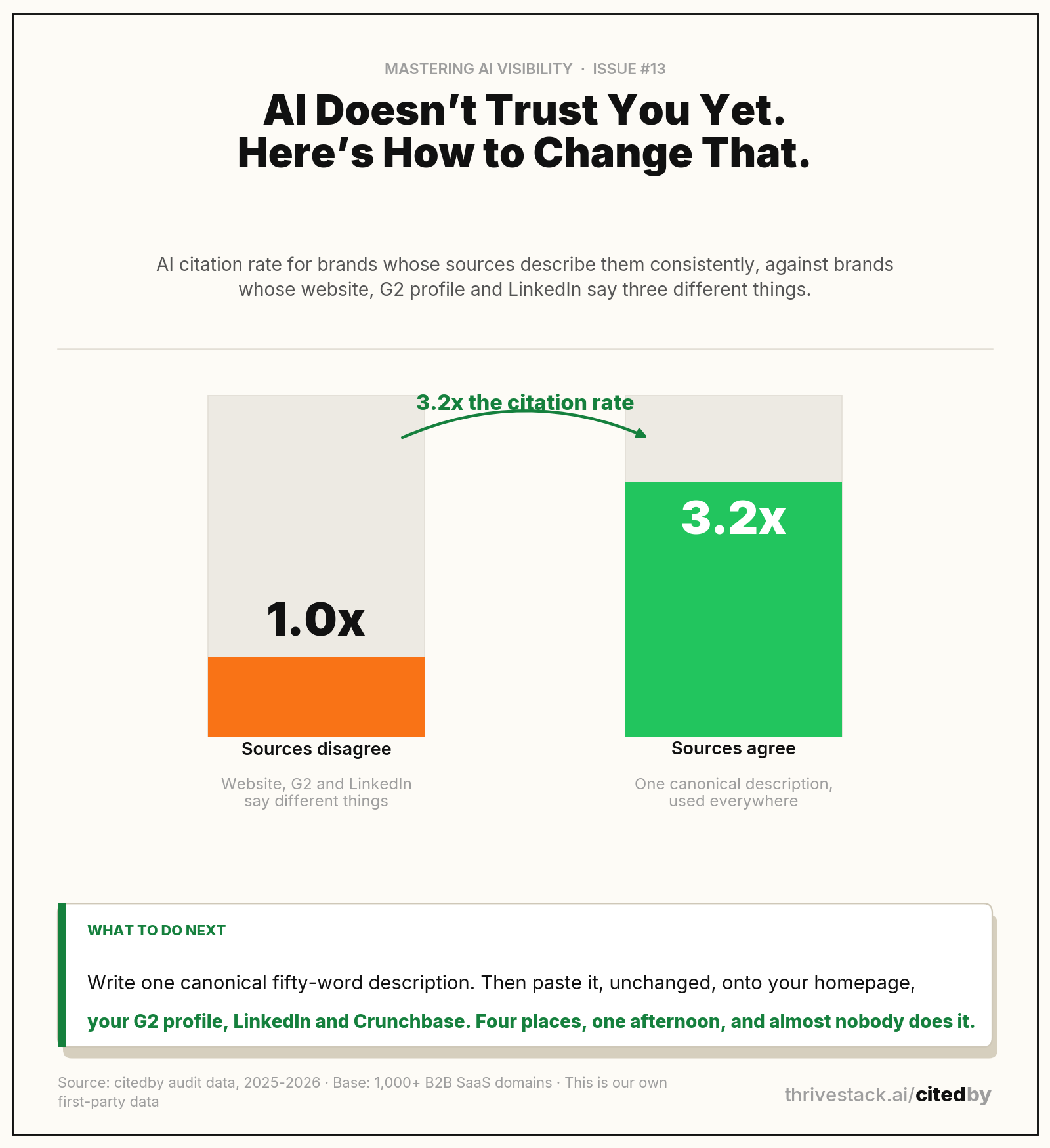
Trust here is not a feeling. It is coherence. Does every source the model can find agree on what you are called, what you sell, and who you sell it to? When the answers line up, the engine cites confidently. When they do not, it hedges, or it names someone easier.
Most B2B brands are incoherent by accident. The website says one thing. The G2 profile says something slightly different, written by someone who left. LinkedIn has a tagline from a repositioning two years ago. Crunchbase has the original 2019 description. Nobody is wrong, exactly. They just do not agree.
against brands whose sources disagree.
AI builds its model of you from every source it can find
Not from your homepage. From all of it, weighted by how much it trusts each source. Your own site is one input, and not the most trusted one, because you are an interested party. That is the whole logic of the 0.664 correlation in Issue #5.
The four-question coherence audit
|
What category does each source place you in?
Does your website say "revenue intelligence"? Does G2 list you under "sales engagement"? Does LinkedIn say "AI-powered analytics"? One brand, three category labels. AI averages them or hedges to the generic. Decide your one category. Enforce it everywhere. This single fix accounts for roughly 40% of the coherence gap we see in citedby audits.
|
|
Who is the stated ICP on each source? Your website might say "B2B SaaS teams." Your G2 reviews skew enterprise. Your press mentions reference SMBs. AI uses all of these to infer your ICP, and if they conflict, it may not cite you for queries from any of them. Decide who you serve most. State it consistently. One ICP descriptor, everywhere.
|
|
What is the most-repeated phrase across all sources? Find the three most common phrases describing your brand across all sources. Is any of them your intended positioning? If not. Your brand description is drifting without your control. The phrase AI repeats most often is whatever appears most consistently across independent sources. Write the phrase you want. Put it everywhere.
|
|
Does your description answer a buyer question? "AI-powered platform" answers nothing. "AEO audit tool for B2B SaaS that scores AI citation visibility across 6 platforms" answers: what it is, who it's for, what it does. AI extracts answers to questions, not category adjectives. Rewrite every description to answer the buyer's implicit question.
|
Your canonical description
One paragraph. Fifty words. Exactly what you want an engine to say about you when a buyer asks. Then it goes everywhere, unchanged, and it stays unchanged.
 |
Jason Barnard
Kalicube · on the Zero-Sum Moment
|
Frequently Asked Questions
How do I get AI to trust my brand?
Why does AI describe my company incorrectly?
How long does it take for corrections to show up?
Have you run this and measured it?
This newsletter is trying to work out whether AI visibility is a real channel or an expensive story. That gets settled by operators, not vendors. If you have run a programme and have numbers, good or bad, we want the case study. The ones that did not work are worth as much as the ones that did.
Book 15 minutes →A 15-minute walkthrough, no pitch. cal.com/thrivestack/citedby-ai-visibility