
In partnership with

Want to get the most out of ChatGPT?

ChatGPT is a superpower if you know how to use it correctly.
Discover how HubSpot's guide to AI can elevate both your productivity and creativity to get more things done.
Learn to automate tasks, enhance decision-making, and foster innovation with the power of AI.
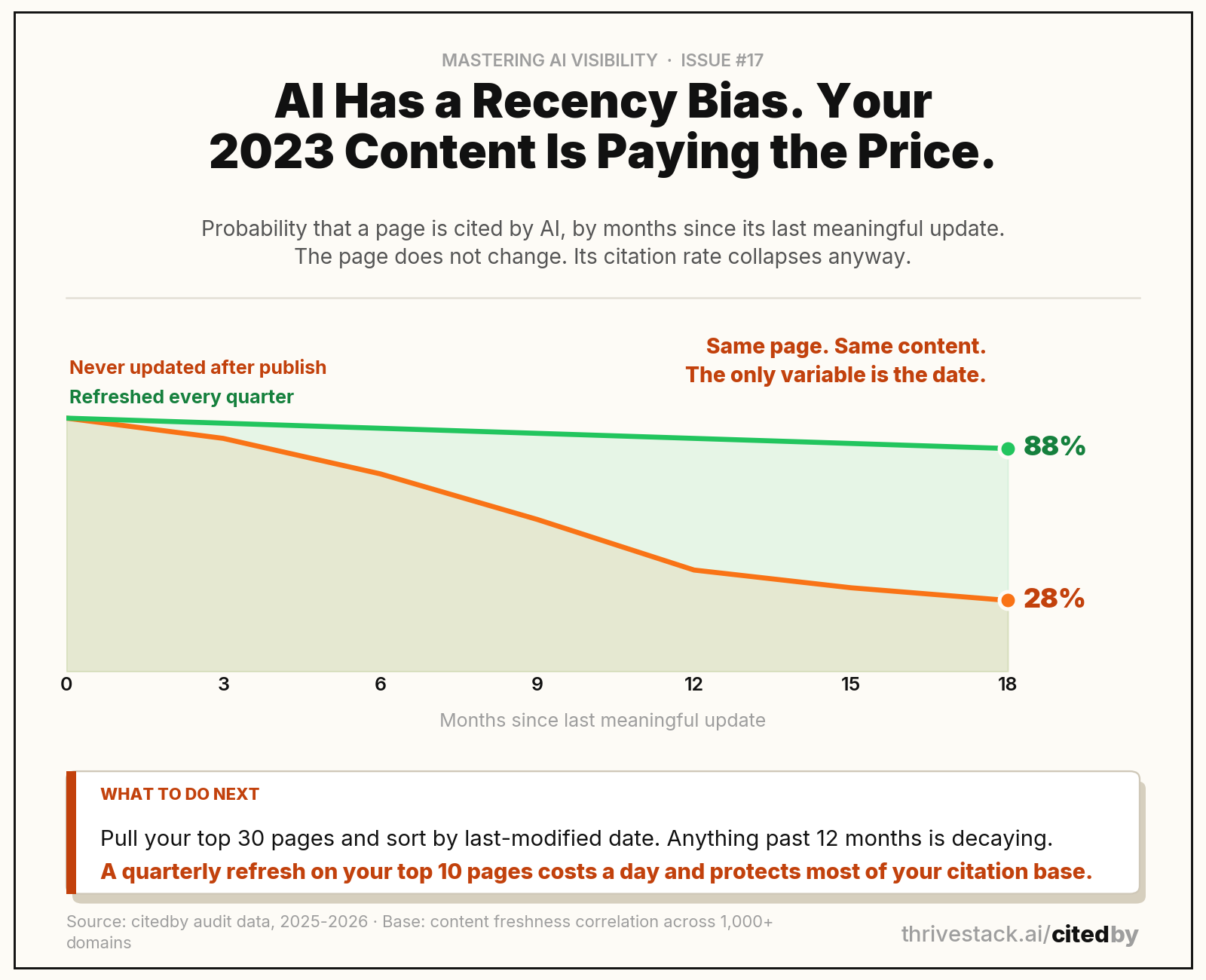
A page that has not been meaningfully updated in twelve months loses roughly 60% of its AI citation probability. The page has not changed. Its content is no less true. It just stopped being recent, and the engines discount it for that.
This is our own audit data, across a thousand-plus B2B SaaS domains, and we are labelling it as ours rather than dressing it up as independent research.
The effect is brutal for B2B, because B2B content is written to last. Your best pillar page, the one that took three weeks and still ranks, is exactly the page most likely to be quietly rotting.
With quarterly refreshes, citation probability stays above 85%.
The four freshness signals engines actually read
1 | Visible dates on the page The dateModified in your Article schema, the visible "Last updated: [date]" text, and the URL date structure if present. All three matter. If a page has no visible date, AI treats it as undated, which it discounts relative to dated content. This is a 30-second fix per page that most teams have never done. |
2 | Year references within the content
A post that says "in 2023" or "last year" without an update signal tells AI the information may be stale. Update year references. Replace "in 2023" with "in 2025." Add a current statistic. These in-content signals reinforce the schema-level date signals, and take 10 minutes per post to fix. |
3 | Link freshness New inbound links signal that your content is being actively referenced. A page that hasn't received a new link in 18 months looks dormant. Fresh content that earns new links (even internal links from recent posts) gets a freshness boost. The easiest freshness link: add a contextual internal link to your top stale pages from every new post you publish. |
4 | Indexed update frequency
Sites with consistent content updates are crawled more frequently, which means new and updated content enters AI retrieval cycles faster. A quarterly update cadence across your top 30 pages trains AI crawlers to visit your domain regularly. That crawl frequency lift benefits every page on the site, not just the ones you directly updated. |
- Update at least one statistic to a current source (not just a newer year, a new source with a 2025 or 2026 date)
- Add or update the visible "Last updated: [Month Year]" marker
- Update
dateModifiedin Article schema to today's date (only after making substantive changes) - Replace any year references older than 18 months with current equivalents
- Add one new FAQ entry based on questions your sales team heard this quarter
- Add one internal link from a recently published post to this page
What counts as a meaningful update
Not changing the year in the title. Not adding a paragraph. Engines are not that easy to fool, and the ones that are will not stay that way.
A meaningful update changes the substance. New data. A new source. A revised recommendation. A section that reflects something that has actually happened since you published. If a reader who had read the old version would learn nothing new, the engine will conclude the same.
 | Kevin Indig Growth Memo · on content decay |
Frequently Asked Questions
Does AI prefer recent content?
How often should I update my content?
Does changing the publish date help?
What counts as a meaningful update?
Have you run this and measured it?
This newsletter is trying to work out whether AI visibility is a real channel or an expensive story. That gets settled by operators, not vendors. If you have run a programme and have numbers, good or bad, we want the case study. The ones that did not work are worth as much as the ones that did.
Book 15 minutes →A 15-minute walkthrough, no pitch. cal.com/thrivestack/citedby-ai-visibility