

In partnership with

AI research, explained in one morning email

Most of what shapes AI next year is sitting in a research paper today. Keeping up with them is a full-time job, and the abstracts don't help.
TLDR AI is the newsletter that does the translating. Each morning you get the handful of papers worth knowing about, curated by Anthropic and ex-Google engineers, with a plain-English summary of what they found and why it matters.
You come away smarter about AI research in the time it takes to finish your coffee.
Free, and delivered to 1.1M+ inboxes every morning.
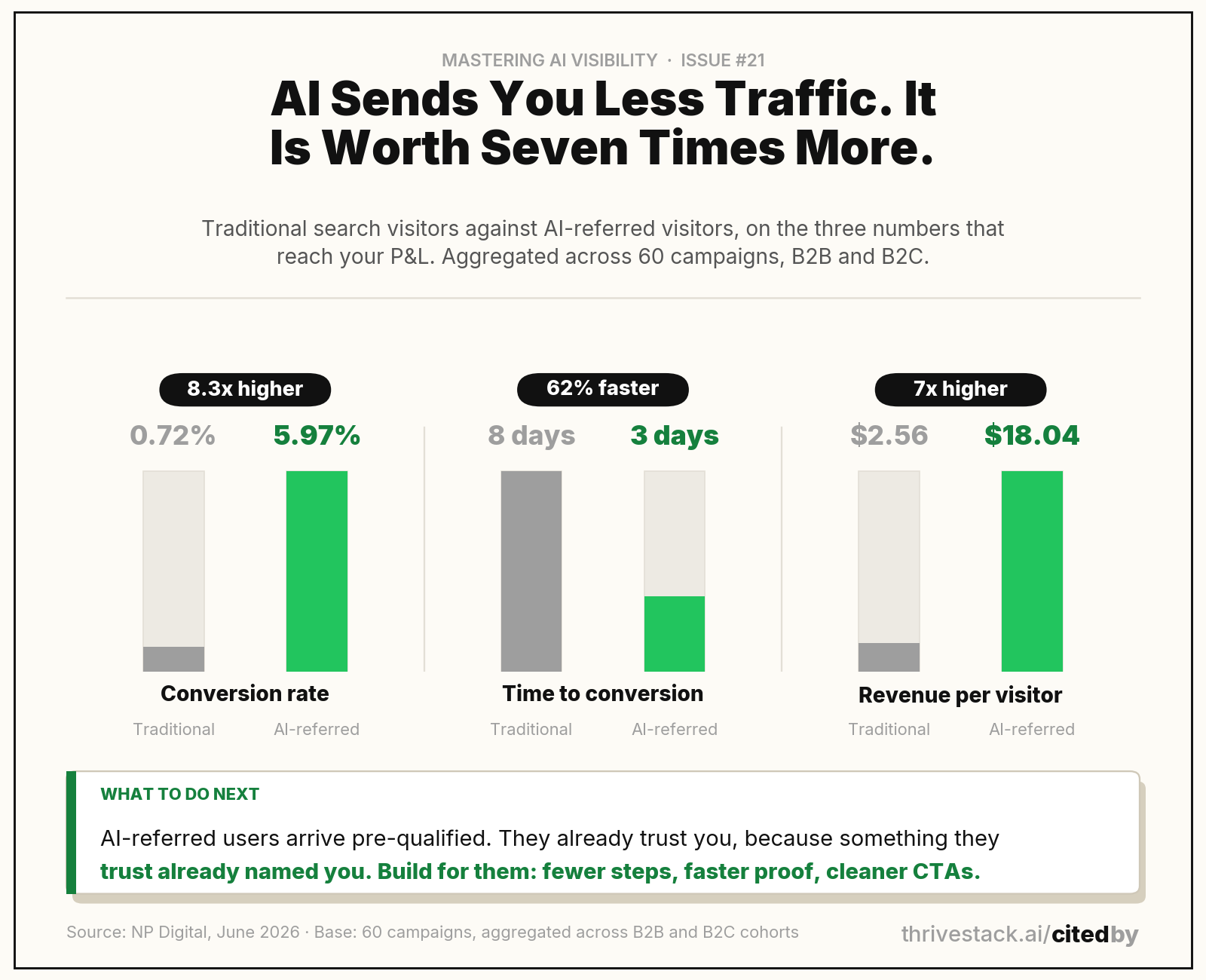
AI-referred visitors convert at 5.97%. Traditional search visitors convert at 0.72%. They close in three days instead of eight. And they are worth $18.04 each against $2.56.
That is NP Digital, aggregated across 60 campaigns in June 2026. Three separate numbers, all pointing the same way, all measuring the same underlying fact: the AI-referred visitor arrives having already decided you are worth considering.
They were not persuaded by your landing page. They were persuaded by something an engine told them, citing a source they trusted, before they ever met you. Your page is not making the argument any more. It is confirming one that has already been made.
AI-referred against traditional search.
One honest caveat before you put this in a board deck. That base is mixed B2B and B2C, which is why the multiple runs hot. The B2B-only benchmark from Opollo, across 312 technology firms, lands at roughly 5x rather than 8.3x. Different studies, different bases, same direction. Quote whichever one looks like your business, and always name the base.
Why the pre-qualified visitor behaves differently
Three days to conversion instead of eight is not a small thing. It is a buyer who has skipped the comparison phase, because the comparison already happened inside the answer.
This has a design consequence most teams have not acted on. Your site is still built for a cold visitor who needs convincing: the long explainer, the trust badges, the six-step nurture. The AI-referred visitor does not need any of it. They need the specific thing they came for, and the fastest possible path to it.
What to change
Segment AI referrals in GA4 as their own channel. Then look at what they actually do. In most B2B accounts they bounce off the long-form nurture path and convert directly, which means every extra step you put in front of them is pure friction.
Then stop reporting this channel on volume. On volume it is a rounding error, and a volume-based read will tell you to ignore the single best-converting source of pipeline you have.
Frequently Asked Questions
Do AI-referred visitors convert better than organic search?
Why do AI-referred visitors convert so much faster?
How do I track AI referral traffic?
Should I build different pages for AI-referred visitors?
Have you run this and measured it?
This newsletter is trying to work out whether AI visibility is a real channel or an expensive story. That gets settled by operators, not vendors. If you have run a programme and have numbers, good or bad, we want the case study. The ones that did not work are worth as much as the ones that did.
Book 15 minutes →A 15-minute walkthrough, no pitch. cal.com/thrivestack/citedby-ai-visibility