|
You cannot report a number you have never taken. This issue builds the number. It takes thirty minutes, uses no paid tools, and produces a figure you can put in front of a CFO.
The output is your AI Share of Voice: the percentage of your target buyer questions where an AI names your brand, scored per engine, tracked weekly.
The baseline itself barely matters. What matters is the trend line. A score of 4% that moves to 19% over a quarter is a working programme. A score of 40% that has never been measured twice is an anecdote.
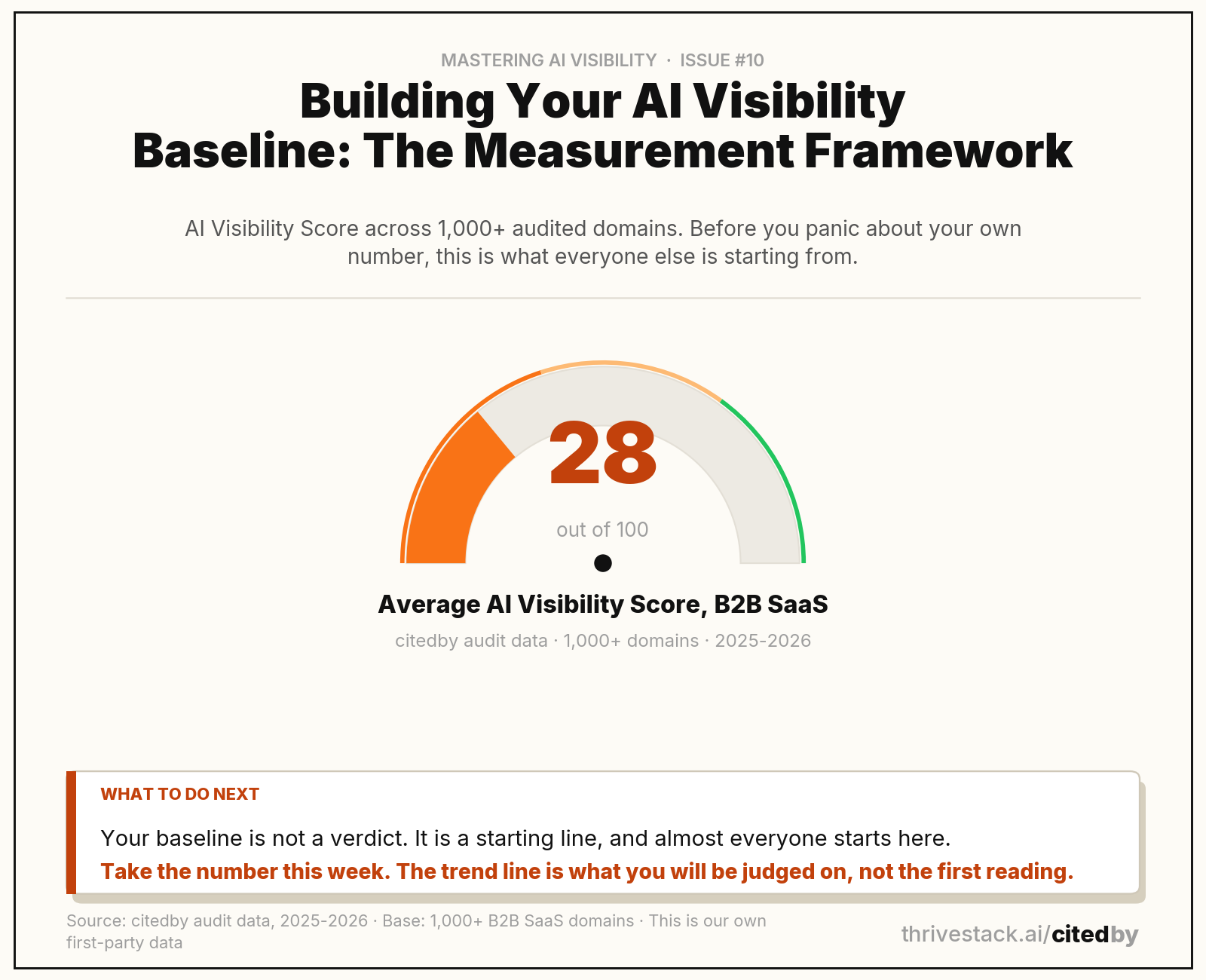
For context before you take your own reading: across the 1,000-plus B2B SaaS domains we have audited, the average AI Visibility Score is 28 out of 100. That is our own data and we are labelling it as ours. Whatever you score this week, you are almost certainly in normal company.
|
For each query, record:
| → Cited? Yes / No |
| → Citation position: #1, #2, #3, or later mention |
| → How was brand described? (accurate / inaccurate / outdated) |
| → Which competitors were cited? (list them) |
| → Citation score: #1=3pts, #2=2pts, #3=1pt, later=0.5, no=0 |
|
The three steps
1 |
Category definition queries (4–5 queries) "What is [your product category]?" · "Best [category] tools 2026" · "[Category] for [your primary ICP]" · "What does a [category] platform do?" These establish your baseline in the widest funnel. |
2 |
Problem-first queries (4–5 queries) The pain points your buyers search before they know your category exists. "[Their problem] solution" · "How to fix [problem]" · "[Symptom] meaning" · "Why is [pain point] happening?" AEO wins here first. Before you even appear in category searches. |
3 |
Comparison queries (4–5 queries) "[Your brand] vs [competitor]" · "Best [category] alternatives" · "[Competitor] replacement" · "[Category] comparison" These are your highest-commercial-intent queries. Being cited in comparison answers is a direct revenue signal. |
4 |
Implementation queries (3–4 queries) "How to [key workflow with your product]" · "How to set up [category]" · "Getting started with [category]" Appear here and you're capturing buyers already committed to the category. Evaluating who to buy from. |
5 |
Brand queries (2–3 queries) "What is [your brand]?" · "Is [your brand] good?" · "[Your brand] review" These reveal what AI actually knows about you, and whether it's accurate. Run these first. Errors here are highest priority to fix. |
Why weekly, and why three engines
Weekly, because you need enough points to see a trend before the budget conversation, not after it. Monthly gives you three data points a quarter and no ability to attribute a change to anything you did.
Three engines, because your visibility is not one number. Citation sets diverge sharply between engines on the same query. Scoring one engine and calling it a baseline will give you a confident, wrong answer.
|
“Your site’s technical foundations decide your visibility in AI search.”
 |
Aleyda Solís Orainti · on AI search crawlability |
Source: Humans of Martech, ep. 202, Jan 2026
|
|
This week's fix
Build the twenty-query sheet and run it once this week, across ChatGPT, Perplexity and Google AI Mode.
Do not optimise anything yet. Take the number, write it down, and date it. Everything you do for the next ninety days is measured against that line.
|
Frequently Asked Questions
What is AI Share of Voice?
The percentage of your target buyer questions where an AI names your brand in its answer, scored separately per engine. It is the closest thing this discipline has to a north-star metric, and unlike traffic it is fully within your control to measure.
|
How many queries should I track?
Twenty is the working number. Enough to be stable week to week, few enough that one person can run the test in twenty minutes. They should be the questions your buyers actually ask at the research stage, not the keywords you wish you ranked for.
|
What if my AI Share of Voice is 0% across every platform?
That is the most actionable starting point there is. Zero means one of three things: the engines cannot crawl you, your content is not structured for extraction, or nobody off-site corroborates you. Issue #4 covers the first, Issue #7 the second, Issue #15 the third. Zero is not failure. It is a brief.
|
Do I need a paid tool to do this?
Not to start. The whole framework runs in a Google Sheet. Buy a platform when the manual test becomes the bottleneck, not before. Buying tooling before you have a baseline is how teams end up with a dashboard nobody trusts.
|
|
thrivestack.ai/citedby
Skip the spreadsheet.
citedby runs your query set across every major engine on a schedule and tracks the trend line for you.
Audit your brand →
No credit card required · Free to start
|
|