
In partnership with


Most AI newsletters get skimmed, then archived. TLDR AI is the one worth opening. It's a free daily email curated by engineers from OpenAI, Adobe, and Google DeepMind. They read everything, then send the model releases, research, and tools that actually matter. It’s a 5-minute read, delivered every weekday morning.
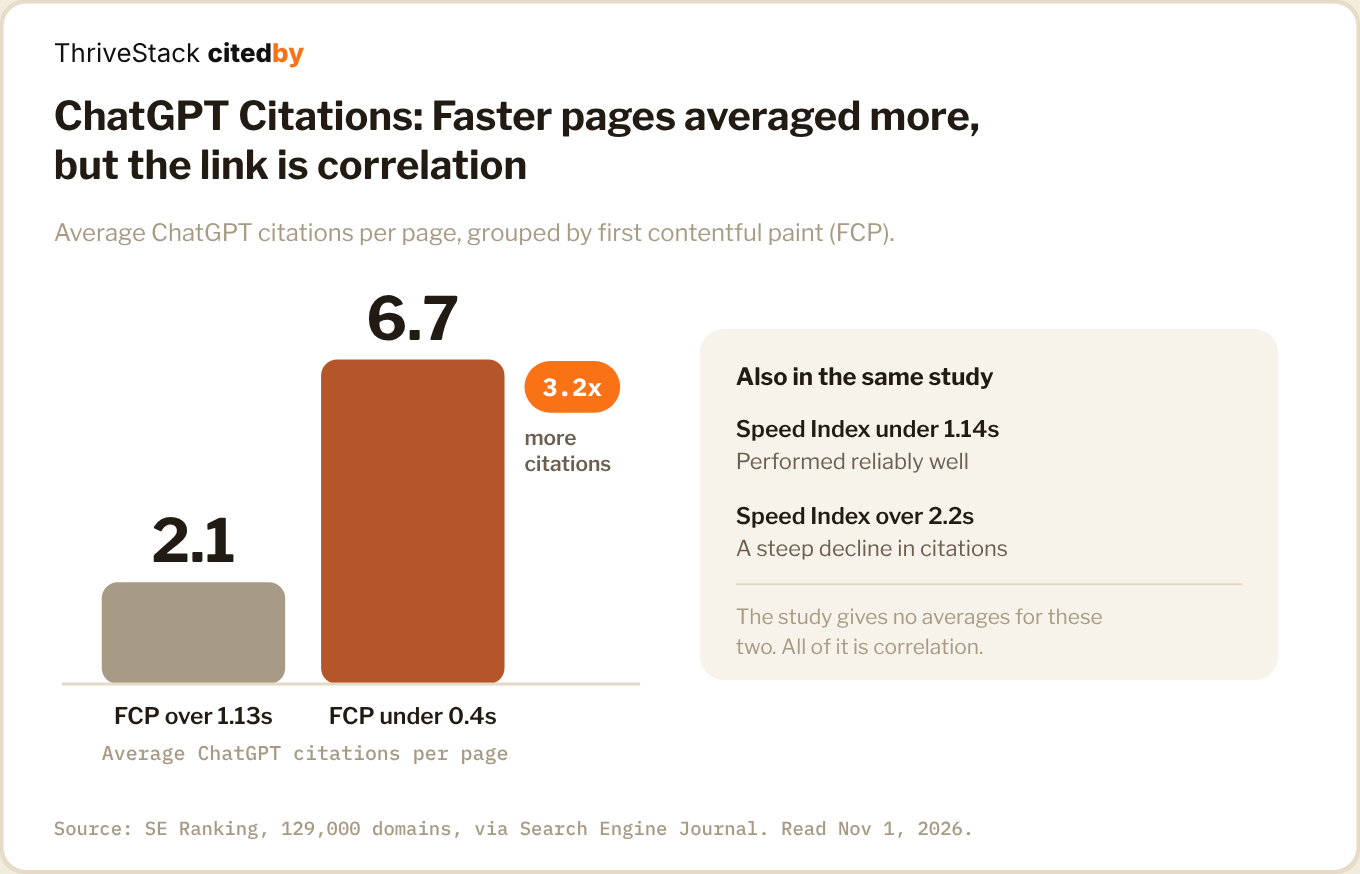
Pages with a first contentful paint under 0.4 seconds averaged 6.7 ChatGPT citations. Pages over 1.13 seconds averaged 2.1. That is about three times more, from SE Ranking’s study of 129,000 domains. The authors call it directional. Faster sites also tend to be stronger sites, so speed may be a sign of quality and not the cause.
We did not want to guess. So we fixed our own pages first, saved a citation baseline before we shipped, and have now run three probes since. This issue is the short version of our page speed and AEO research. You get the speeds that look good enough, what we changed, and how to run the same test.
Correlation, not proof.
1. What page speed is good enough to get cited?
No AI engine publishes a speed cutoff, so no number guarantees a citation. The public data points one way, though. Use Google’s “good” limits as your floor, because they are the only thresholds with a published source.
HTML response time (TTFB): 0.8 seconds or less. First contentful paint: 1.8 seconds or less, with SE Ranking’s best group under 0.4. Largest contentful paint: 2.5 seconds or less. Layout shift (CLS): 0.1 or less. Interaction to Next Paint: 200 milliseconds or less. Only first contentful paint has a public AI citation figure.
Server response and the text in your HTML reach a crawler directly. Fix those first. Largest paint, layout shift and interaction delay mainly help your visitors.
2. How do you cut largest contentful paint?
Remove what blocks the first paint. In Lighthouse on mobile, our slowest page fell from 8.65s to 2.92s. Four of the five pages we sampled got faster.
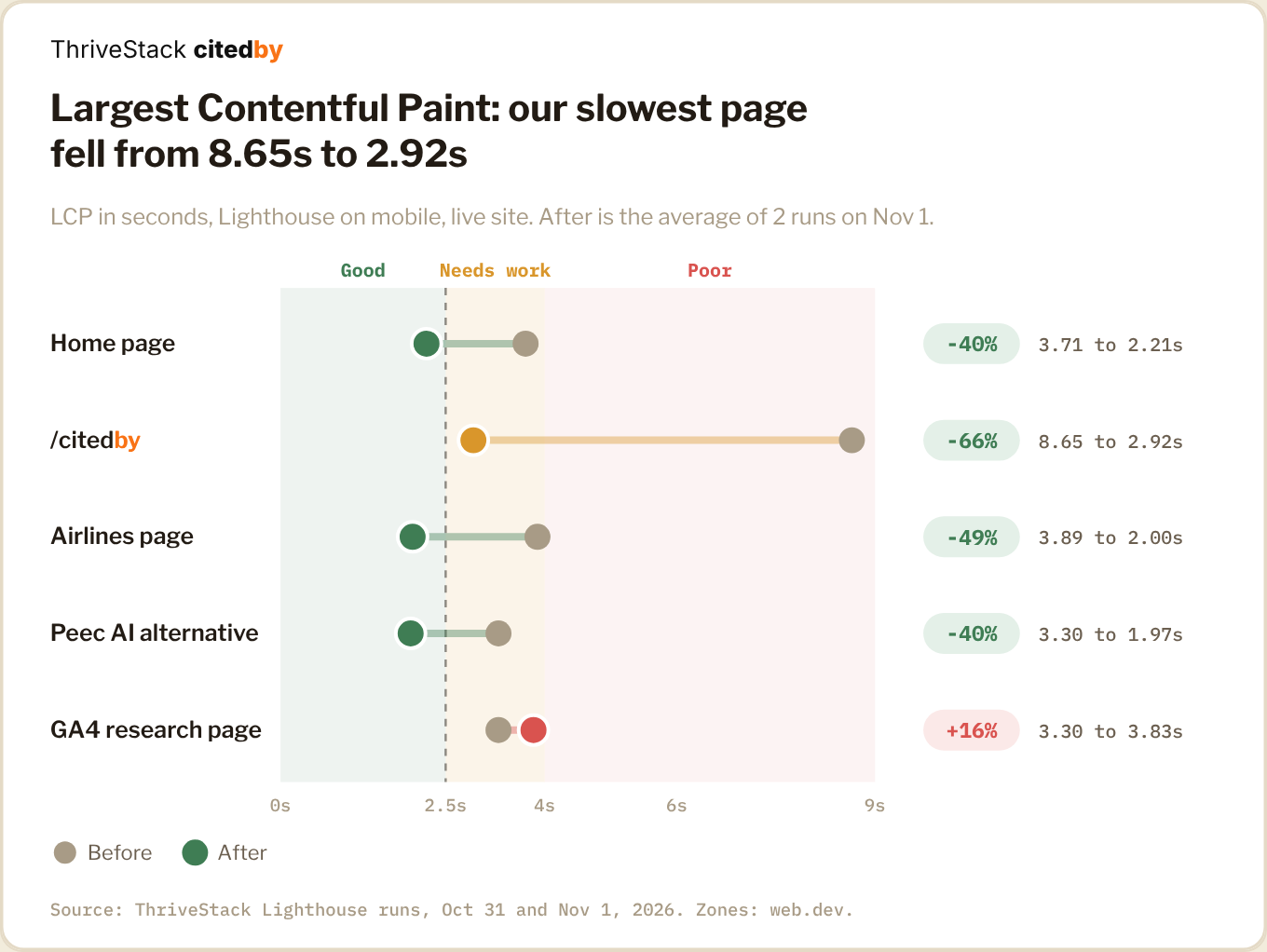
Largest contentful paint, before and after, five of our pages. Lighthouse on mobile, live site, after is the average of 2 runs on Nov 1, 2026. Same figure as the ThriveStack citedby research article.
Critical CSS. Pages loaded a 393 KB stylesheet before showing anything. Each page now inlines its own rules and loads the rest without blocking. Less JavaScript up front. A shared helper pulled a chart library onto every page. Preloaded JavaScript fell from about 400 KB to about 150 KB gzipped. No hero image. We rebuilt the hero in HTML and SVG and shrank headshots from 685 KB to 6 KB. Page weight fell from 1,378 KB to 727 KB.
One page went the wrong way. Our GA4 research page averaged 3.83s against 3.30s before, because its server took 2.4 to 3.5 seconds to respond. Front-end fixes cannot help with a slow server. That page is next.
3. How do you fix cumulative layout shift?
Size your fallback fonts to match your web fonts, move decorative glows with a transform, and keep line breaks that do not change as fonts load. Pages over the 0.1 limit fell from 8 to 0 on our live site.
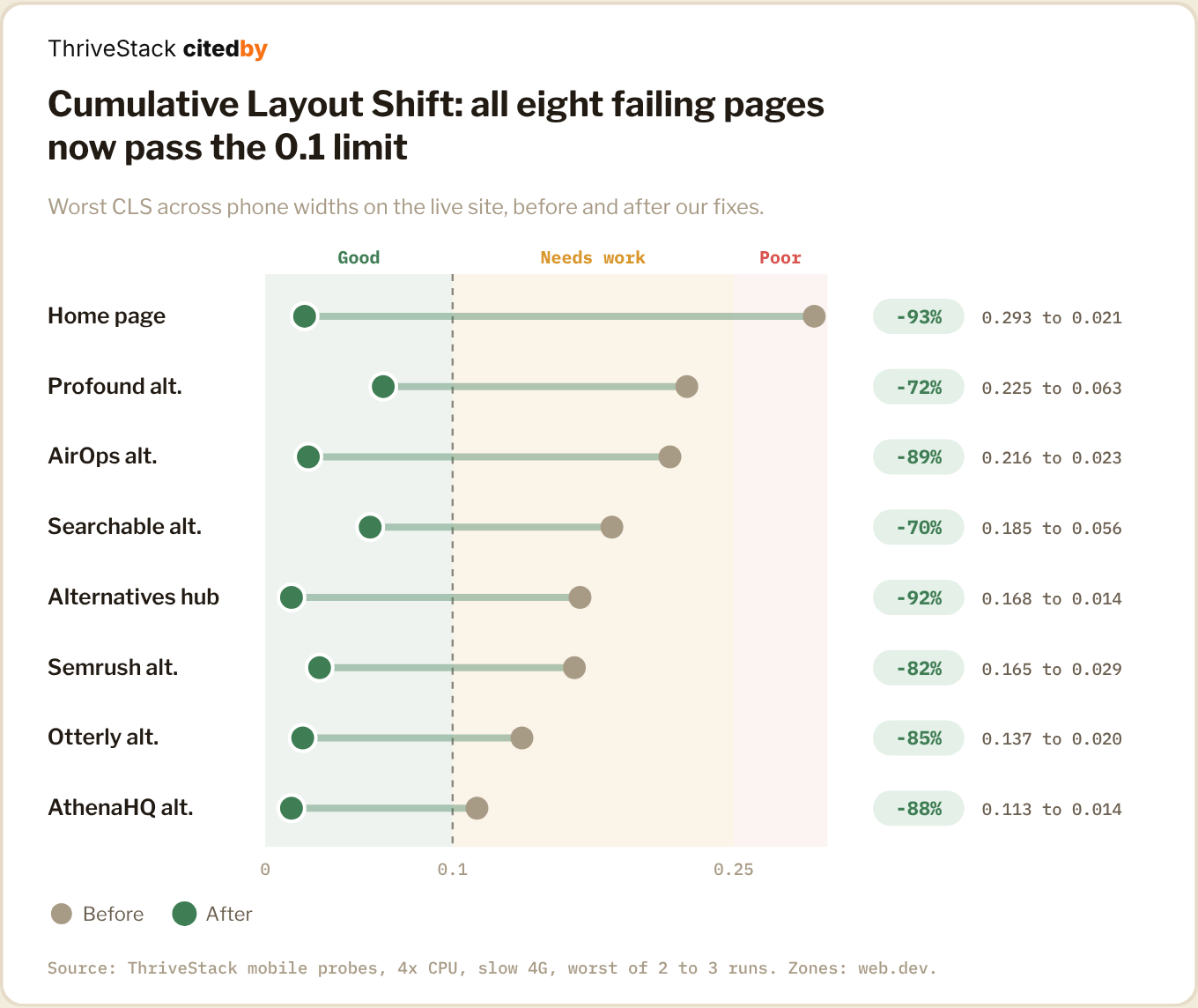
Cumulative layout shift, before and after, eight pages at phone widths. Same figure as the ThriveStack citedby research article.
Our home page surprised us. Fonts were not the cause. Its hero tabs change every 5 seconds at different heights, which moved a glow by up to 463px. A short test missed it and Lighthouse caught it. On one page at 360px, our first fix made CLS worse, from 0.165 to 0.269. A line break after the H1 colon and one in the intro brought it to 0.029.
 | Aleyda Solís Orainti · on AI search crawlability |
4. Does page speed affect AI answers the way it affects SEO?
Not the same way, and the AI side is correlation so far. Vercel and MERJ found that none of the major AI crawlers run JavaScript. A crawler never paints your page, so it never sees a layout shift. Our reading is that largest paint and layout shift help people, and reach AI answers only indirectly, through rankings and links.
Server response time and the text in your HTML reach the crawler directly. Put your answers in the server-rendered HTML first. Then fix speed, because visitors and rankings benefit either way.
5. What happened to our citations after the fixes?
Not enough to credit the fixes yet. We ran probes on November 1, 3 and 4. Visibility rose from 9.4% to 27.6%, and raw retrievals went from 33 to 91, 94 and 82. But our prompt list grew from 32 to 45 prompts over the same days, and more prompts means more retrievals.
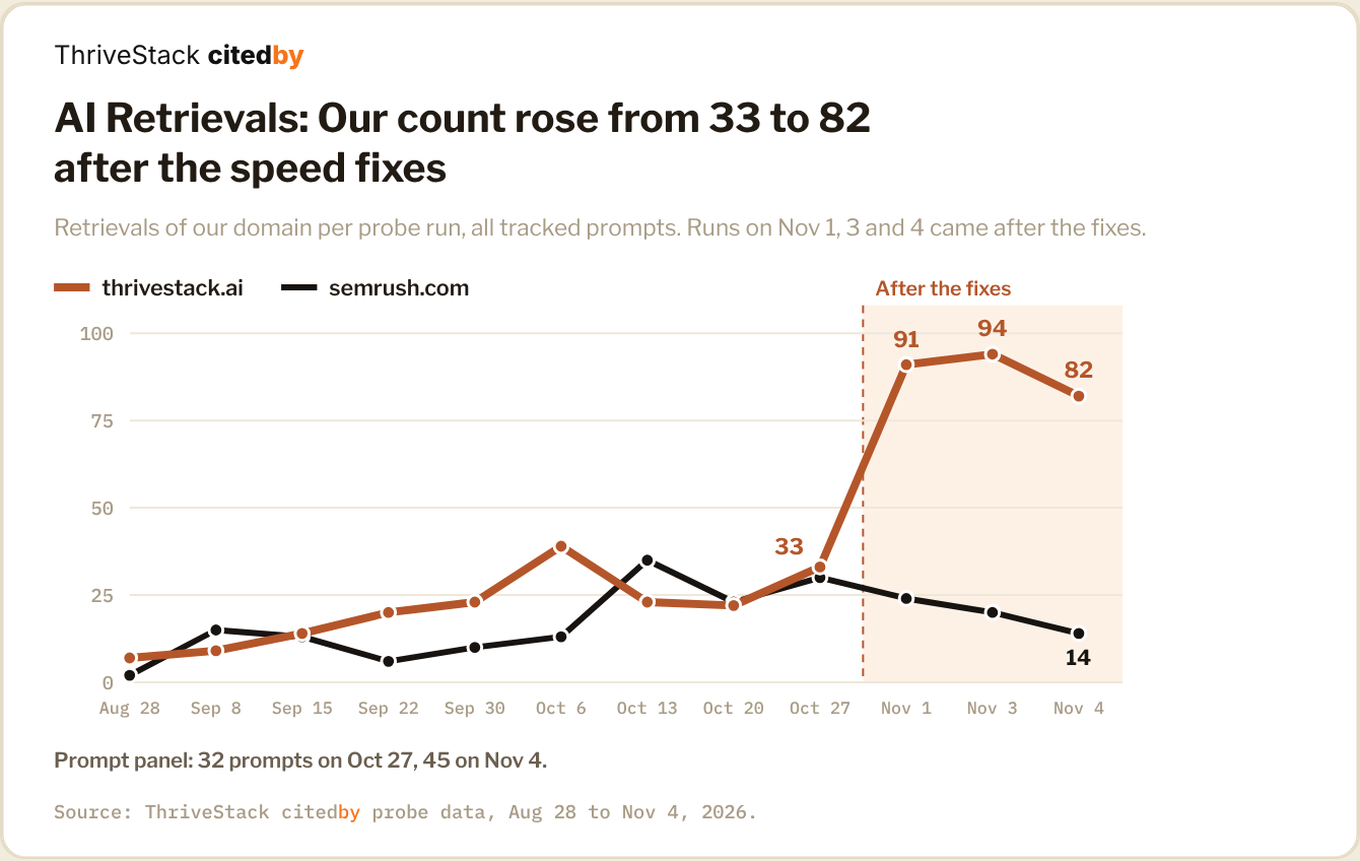
Our AI retrievals per probe run. The prompt list grew from 32 to 45 after October 27. ThriveStack citedby probe data, Aug 28 to Nov 4, 2026. Same figure as the ThriveStack citedby research article.
So we compared like for like, on the original 32 prompts only. Visibility moved from 9.4% to 12.2%, and cited rate from 9.4% to 11.1%. That sits inside our normal range. Also, our retrievals went from 14 to 39 and back to 22 with no speed work at all. One good run after a fix proves nothing. You need several probes, and you need to compare against the competitors in the same answers. Our test has a limit we cannot remove: the speed work shipped alongside new content on the same pages, so a rise could have several causes.
6. How do you test it on your own site?
Save a citation baseline before you ship. Use the same weekly prompts on the same engines for four weeks after. Track retrievals, citations and visibility, and compare with the competitors in those answers. ThriveStack citedby runs your prompts on the engines your buyers use each week, so you can see what moved after a change.
Check the basics in this order. Is your answer text in the server HTML? Is your HTML response 0.8 seconds or less? Does the URL return a 200 with no redirect chain? Does robots.txt allow the AI crawlers you want? Does the page still show its text with JavaScript off? Then clear Google’s good limits for first paint, largest paint, layout shift and interaction delay.