

In partnership with

Find what’s slowing your GTM.

Most GTM problems aren’t one big failure. They’re one or two weak spots quietly dragging down the rest.
The free GTM Audit scores your go-to-market across four dimensions, then sequences a 90-day roadmap for your stage.
Drop your URL. Get your score in about 10 minutes.
Prompts are not keywords, and the instinct that served you in SEO will actively mislead you here. There is no volume column. There is no ranking. And the single most common mistake is treating prompt selection as a keyword export.
Tomek Rudzki puts it plainly: marketing managers keep asking for the top 50 prompts by volume so they can optimise those. That is not how AI search works. One buying decision spans multiple prompts across multiple stages, and volume tells you nothing about which stage you are invisible at.
Everyone tracks "best [category] tools" and calls it done. That is one stage out of five.
The five stages, and the one nobody tracks
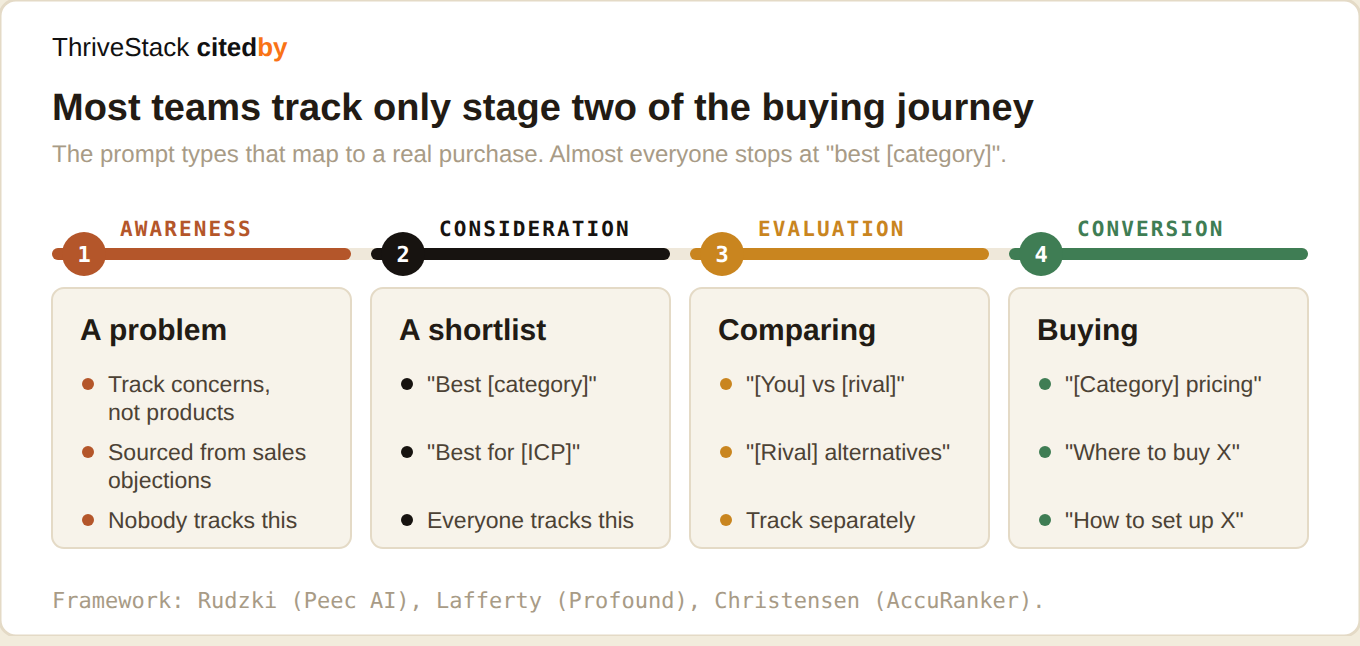
Awareness. The buyer has a problem, not a shortlist. They do not yet know your category exists, let alone your brand. The prompts here are concerns, not products.
Rudzki's example is the sharpest thing in any of this literature. A buyer worried about electric cars asks "will electric vehicles hold their value?" The engine answers honestly, yes they depreciate, and then adds that strong brands like Tesla hold value better. Tesla just got positioned as the exception to the buyer's exact fear, and Tesla was never mentioned in the prompt.
That is the largest pool of buyers in the funnel and almost nobody is measuring it. To build these prompts you do not brainstorm. You go and find the objections your sales team hears every week.
Consideration. "Best [category] tools." "Best [category] for [ICP]." This is the stage everyone already tracks, and it is fine, and it is not enough. Track the segment-specific variants too, because "best CRM" and "best CRM for a five-person sales team" return very different answers.
Evaluation. "[You] vs [competitor]." "[Competitor] alternatives." This is where deals are lost, and it hides a measurement trap we will come back to.
Conversion. "Where can I buy X." "[Category] pricing." Rudzki is blunt that B2B companies should mostly skip this stage. It matters for ecommerce and retail. It rarely matters for enterprise software.
Post-purchase. Nick Lafferty adds a stage the others leave out: "how do I set up X", "how do I contact X support". Your customers are asking engines how to use your product. If the engine gets it wrong, that is a support cost and a churn risk, and it is invisible to you.
The measurement trap in comparison prompts
This is the most useful thing in the source material and it is easy to miss.
When you track "[Your brand] vs [Competitor]", your visibility on that prompt is 100%. Guaranteed. You are named in the prompt, so the engine names you in the answer. It is not a signal. It is a tautology.
Mix those rows into your main tracking set and they inflate your overall score, hiding weakness everywhere else. Rudzki recommends keeping brand-comparison prompts in a completely separate project. Lafferty says the same thing differently: keep branded prompts to a small percentage and weight the set heavily toward unbranded, because unbranded prompts are the only ones that tell you how prospects who have never heard of you are being answered.
Which is why those rows belong in a separate sheet.
Where to actually get the prompts
All four published frameworks converge on the same sources, which is reassuring, because they disagree about almost everything else.
Convert your Search Console keywords into questions. Not paste them. Convert them. "best short-form video editing tool" becomes "what is the best short-form video editing tool for creators?" Pull your top 50 to 100 non-branded queries and rewrite each one as a person would actually say it out loud.
Mine your sales calls. Every source names this and Rudzki calls discovery-call recordings a goldmine. The objections your reps answer on repeat are your awareness-stage prompts, already written, in your buyers' own words.
Read your support tickets. That is your post-purchase set, free.
Ask your leads directly. Lafferty's suggestion is the cheapest thing here: change your "how did you hear about us" form field to ask what they typed. Not which channel. The actual prompt.
Reddit and Quora. People write questions there the way they write them to an engine. Sille Christensen also points at People Also Ask boxes, which are a free, structured list of the adjacent questions engines already associate with your topic.
Ask an engine, then distrust it. "What questions do people ask about [category]?" is a legitimate starting point and every source says so. Every source also warns that models generate plausible questions, not your buyers' questions. Validate the list against your sales team before a single row goes into the sheet.
Nobody agrees on how many
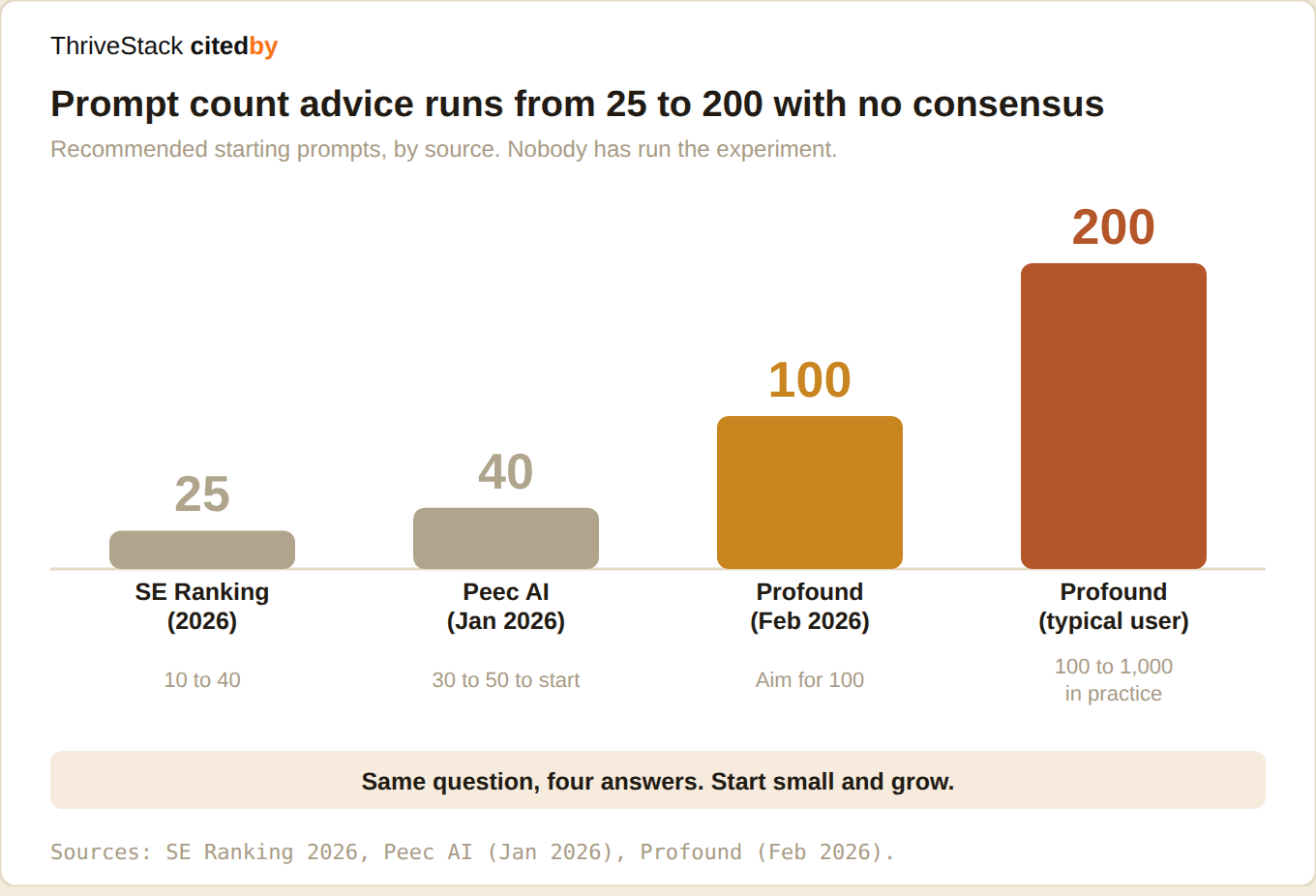
Recommended starting prompt count, by source. A 25x spread. Nobody has run the experiment.
SE Ranking says 10 to 40. Rudzki suggests 30 to 50 to start. Lafferty says aim for 100, and reports that customers typically run 100 to 1,000.
That is a 25x spread on the most basic question in the discipline, and it should tell you something: nobody has run the experiment. Every one of these numbers is a considered opinion, not a finding.
Our advice is to start at the low end. A set of forty prompts you actually read every week beats four hundred you glance at monthly. Add prompts when the data shows a stage is missing, not because a vendor suggested a number.
The signal hierarchy: what to fix when you lose a prompt
Knowing you are invisible on a prompt is only half of it. The other half is knowing which lever moves it.
NP Digital scored seven trust signals across six engines in June 2026, and the ordering is remarkably stable. Third-party citations top almost every engine, 4.5 to 4.8 out of 5. Expert authorship and brand mentions follow, 4.0 to 4.7. Reviews sit in the mid threes.
Then it gets engine-specific. Backlinks score 3.9 on Google AI Overview and 1.9 on ChatGPT. Community engagement scores 4.0 on Perplexity and 1.5 on Claude. Structured data comes last everywhere, as low as 1.4.
So the hierarchy is: get corroborated off-site, put a real expert's name on the page, earn reviews, and treat schema as hygiene. In that order. If you lose an awareness prompt, the fix is almost never on your website.
Impact on AI citation, scored 1 to 5, across six engines.
Two things that will break your tracking
Personalisation. Two people asking the identical question can get different answers, because engines increasingly use personal context. Gemini's Personal Intelligence lets users opt into having their email and Drive read to shape responses. This means your "visibility" on a prompt is a distribution, not a value, and any tool reporting a single crisp number is simplifying something it should not.
Geography. Rudzki cites Revolut at 60% visibility in the UK and 40% in the US on the same prompts, ranking first in AI Overviews in one and third in the other. Same brand, same questions, different answers. If you sell across regions and track one, you are measuring one market and reporting it as the world.
The tracking sheet
The two annotated rows are the entire reason to build this. You are not listed as an alternative to your own competitor, and there is an awareness prompt where the engine names nobody at all. That second one is an open goal, and it is the kind of row a volume-driven prompt list will never surface.