NP Digital scored seven trust signals across six engines. Third-party citations topped almost every column, at 4.5 to 4.8. Structured data came last, at 1.4 on ChatGPT.
Read that grid by row, not by column. Your weakest row is your cheapest win. Lifting one weak signal to a 4 moves more visibility than perfecting a signal you are already scoring 4.6 on.
Two cells deserve a second look. Backlinks score 1.9 on ChatGPT and 3.9 on Google AI Overview, which tells you the engines have genuinely different priors. And community engagement scores 4.0 on Perplexity against 1.5 on Claude, which is why a single blended AEO strategy underperforms.
4.7 vs 1.4
Third-party citations against structured data. Impact on AI citation, scored 1 to 5.
The gap is the entire prioritisation argument.
NP Digital · June 2026 · Base: 100 marketers interviewed
What a named entity actually is
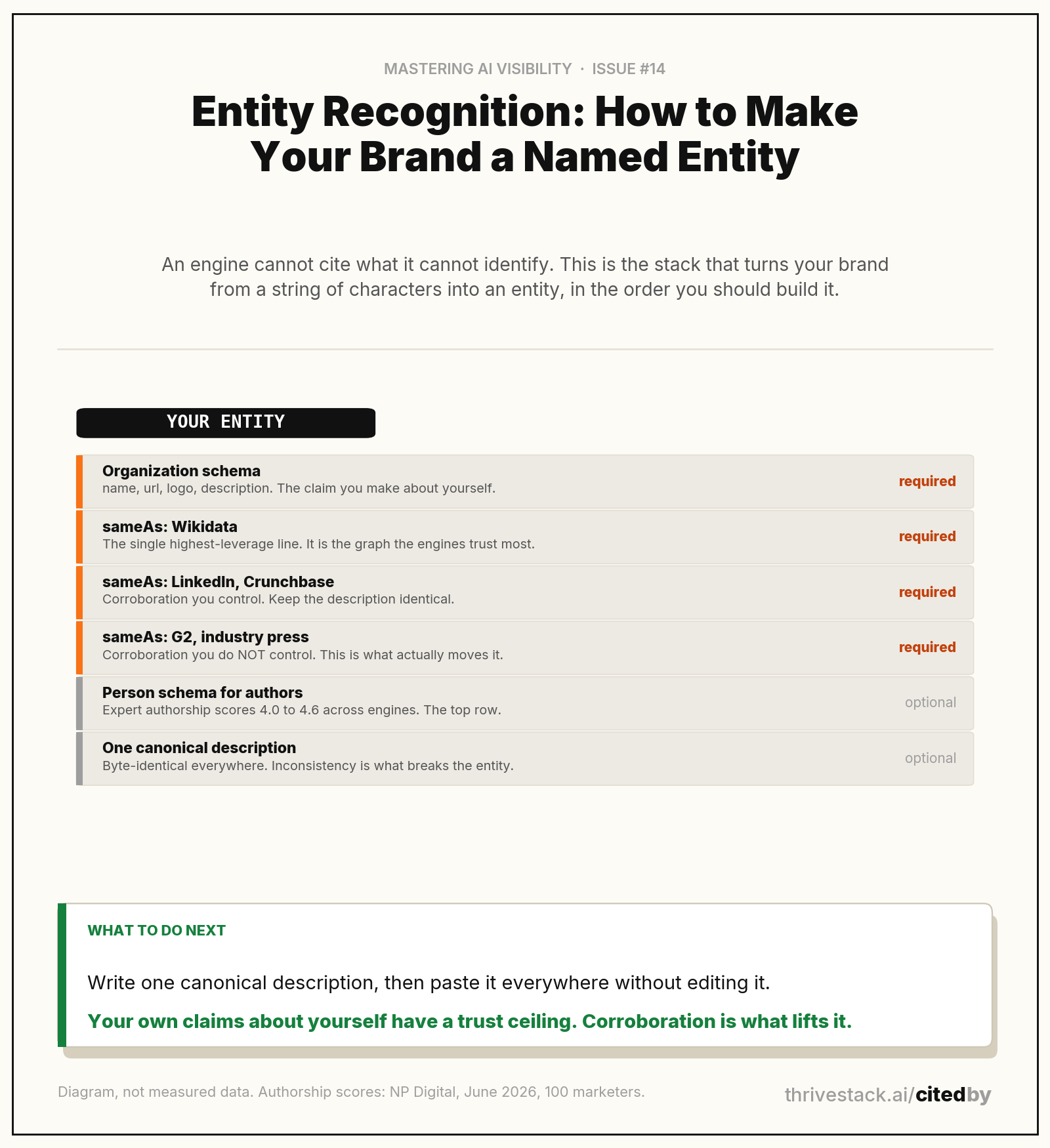
An entity is a thing a machine can identify unambiguously and connect to other things. Not a string of characters, a node. Your company becomes an entity when enough independent sources describe it the same way and cross-reference each other.
Definition
Entity recognition
: the process by which an AI language model identifies a proper noun as referring to a known, distinct entity with verified attributes. Rather than an unknown string. Brands with strong entity recognition are cited by name. Brands without it are paraphrased or skipped. Entity recognition is built, and it's buildable in a specific, predictable sequence.
sameAs: the technical foundation
// Organization schema with entity linkage. Deploy in on every page { "@context": "https://schema.org", "@type": "Organization", "name": "[Your Brand Name]", "url": "https://yourdomain.com", "description": "[Your canonical 40-60 word description, same as Issue #13]", "sameAs"
: [ "https://en.wikipedia.org/wiki/[Your_Brand]", // Tier 1. Pursue as long-term goal "https://www.wikidata.org/wiki/[Q-number]", // Tier 1. Achievable this week "https://www.linkedin.com/company/[handle]", // Tier 3. Complete profile first "https://www.g2.com/products/[slug]/reviews", // Tier 2. 20+ reviews needed "https://www.crunchbase.com/organization/[slug]", // Tier 3. Fill all fields "https://twitter.com/[handle]", // Tier 3 "https://www.youtube.com/@[channel]" // Tier 3. If active ] }
The steps
1 |
Search for your brand at wikidata.org
If an entry exists: click through, verify all fields are accurate. Particularly instance of: business, industry, founded, headquarters location, and official website. Note the Q-number (e.g., Q12345678). Add it to your Organization schema's sameAs array.
|
2 |
If no entry exists: create one Go to wikidata.org → Create new item. Add a label (your brand name), a description (one short sentence: "AI visibility platform for B2B SaaS"), and these properties: instance of (P31) → business (Q4830453); official website (P856) → your URL; founded (P571) → your founding date; headquarters (P159) → your city. Free account required. Takes 20 minutes.
|
3 |
Add your Q-number to your sameAs schema Format: "https://www.wikidata.org/wiki/Q[your-number]". This creates a direct link between your website's schema and the Wikidata entity record. The most impactful single addition to Organization schema most B2B SaaS teams haven't made.
|

“Brands that win in AI-driven discovery are the ones that machines already understand, trust, and recommend.”

Jason Barnard
Kalicube · on AI-driven discovery
Source: Kalicube
This week's fix
Check your Wikidata entry today. If it does not exist, create it. If it does, add every missing property and cross-reference it with your sameAs block.
Wikidata is a Tier 1 entity signal and it is free. It is the highest ratio of signal to effort available in this discipline.
Frequently Asked Questions
What is entity recognition in AI search?
The process by which an engine identifies your company as a specific, unambiguous thing rather than a string of words, and connects it to related entities: your founders, your products, your category, your competitors. Until you are an entity, you are a phrase, and phrases do not get recommended.
Which trust signals do AI engines reward most?
NP Digital measured seven across six engines in June 2026. Third-party citations scored highest almost everywhere, between 4.5 and 4.8 out of 5. Expert authorship and brand mentions followed. Structured data scored lowest, as low as 1.4 on ChatGPT. The ordering is remarkably stable across engines, with the exception of backlinks and community engagement, which vary sharply.
What is the sameAs property?
A schema.org property that links your Organization entity to your other authoritative profiles: Wikidata, Crunchbase, LinkedIn, G2. It is how you tell a machine that these scattered records all describe the same thing. It is one of the few cases where a technical change directly supports an off-site signal.
Do I need a Wikipedia page?
It helps enormously and you almost certainly cannot get one on demand. Wikidata, by contrast, you can create today, and it carries most of the entity-linkage value. Start there. Wikipedia is a long game and it cannot be forced.
thrivestack.ai/citedby
Score your entity signals.
citedby checks your entity presence across Wikidata, Crunchbase, G2 and the rest, and generates the sameAs block to link them.
Audit your brand → No credit card required · Free to start