
In partnership with

Your GTM Has a Weak Spot. Find It.

Your go-to-market feels stuck. Most of the time, nothing is broken. One or two things are just quietly costing you momentum.
Drop your URL. The free GTM Audit reads your site, pricing, and competitors, scores four dimensions, and hands you a 90-day fix list.
10 minutes. No guessing.
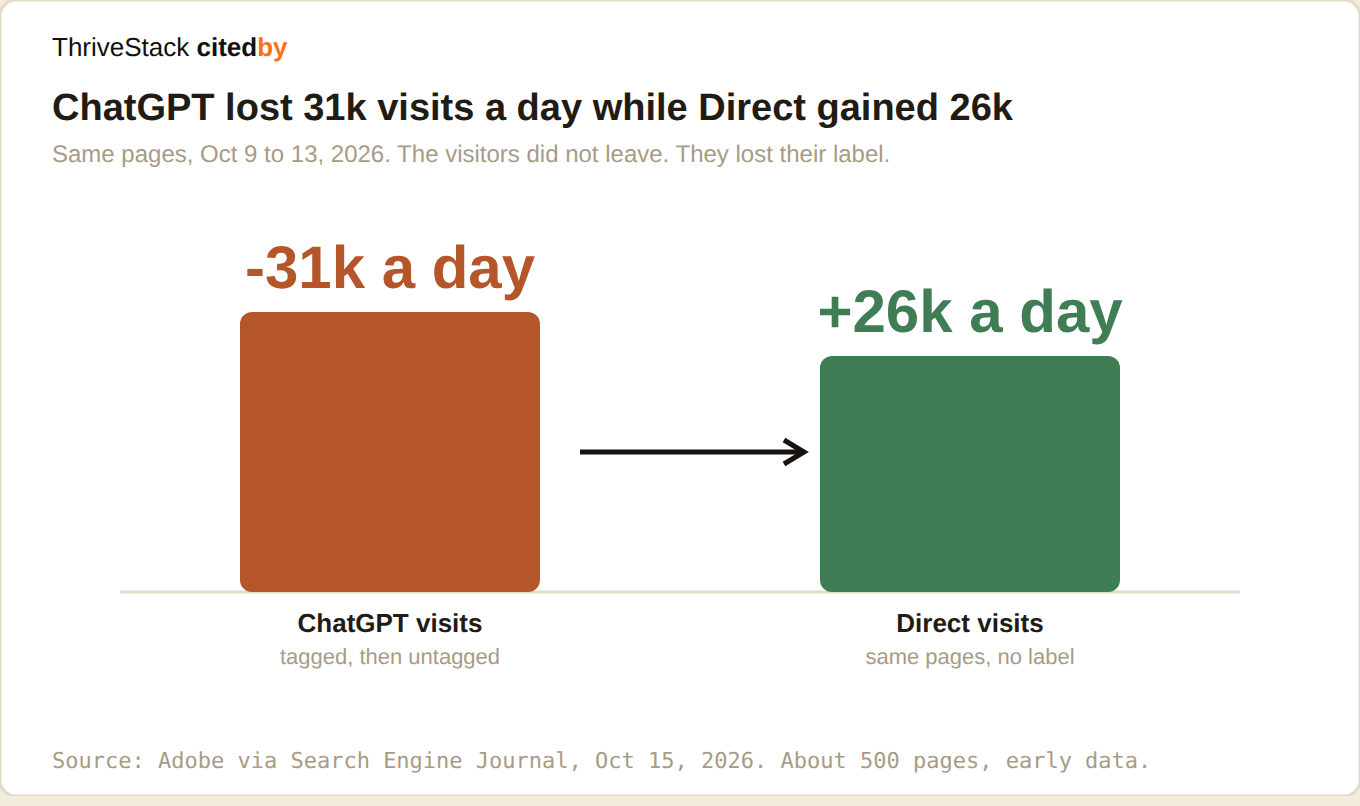
On October 9, 2026, ChatGPT stopped tagging its links, and your AI traffic report quietly went wrong. Here is how to track AI traffic when the tag that identifies it vanishes. Adobe measured the drop across about 500 pages. ChatGPT visits fell by roughly 31,000 a day, and Direct visits rose by 26,000.
The visitors did not leave. They lost their label. Cedric Huesler, a senior director of product management at Adobe, traced it to GPT-6 opening links in a way that removes the utm_source tag and the referrer together. He said OpenAI confirmed a bug. The fix began on October 15, six days later.
The next change will not announce itself either. So this issue is not about one bug. It is about building a way to track AI traffic that survives a missing tag.
Remove the tag and almost nothing else tells you where the visit came from.
 | Cedric Huesler Adobe · Senior director of product management, on the ChatGPT tag drop |
1. Know which engines tag their links, and which do not
Only ChatGPT is widely seen adding utm_source. Even then, Search Engine Journal reported that it tags only links in answers grounded in web sources. Gemini tags are reported but undocumented. Search Engine Journal covered the first reports, and John Mueller said he sees them too.
| Engine | Adds utm_source? | What to rely on | |
|---|---|---|---|
 | ChatGPT | Yes | utm_source=chatgpt.com on links in web-grounded answers. Dropped Oct 9, back Oct 15. |
 | Gemini | Reported | Seen by users and by John Mueller. Google has not documented it. |
 |
Claude | None found | Referrer claude.ai, inconsistent. |
 |
Perplexity | None found | Referrer perplexity.ai. |
 |
Copilot | None found | Referrer copilot.microsoft.com. |
 |
Grok | None found | Sources disagree on the domain: grok.com or grok.x.com. |
 |
Mistral Le Chat | None found | Referrer chat.mistral.ai. Small share. |
 |
Meta AI | None found | Referrer meta.ai. |
Which AI engines add a UTM tag, as of Oct 16, 2026. Source: ThriveStack citedby research, a first-party review of public reports (full method). Evidence is thin outside ChatGPT. “None found” is not proof.
Read the table as a to-do list. For every engine marked “None found,” your only identifier is the referrer domain. That is the first thing a strict browser setting or an app handoff removes.
2. Test every engine yourself, once a month
Nobody can tell you what an engine does to your links today. You have to click and look. It takes ten minutes.
1 | Ask each engine a question your buyers ask Pick one that returns a cited link. Do it on desktop and on the mobile app. The app is where tags go missing first. |
2 | Click the cited link and read the landing URL Is utm_source
in the address bar? Write down the exact value. Some engines add a source and no medium. |
3 | Check what GA4 calls the visit Open Realtime on your own property while the page loads. Note the source and the channel. A tagged click can still land in the wrong channel. |
4 | Log it and repeat after every big model launch GPT-6 changed link behavior with no notice. A calendar reminder on launch days is cheaper than a week of bad data. |
2026-10-17 | chatgpt | desktop | yes: chatgpt.com | chatgpt.com | AI Assistant
2026-10-17 | chatgpt | iOS app | check | check | check
2026-10-17 | perplexity | desktop | no | perplexity.ai | Referral
3. Track AI traffic by source and referrer, not by tag alone
Match on two things at once. The utm_source value catches tagged clicks. The referrer domain catches the rest. If you built the channel group from Issue #30, add the tag values to it now.
# Admin -> Data display -> Channel groups
Condition: Source matches regex
chatgpt\.com|chat\.openai\.com
|gemini|gemini\.google\.com
|perplexity\.ai|claude\.ai
|copilot\.microsoft\.com
|grok\.com|chat\.mistral\.ai|meta\.ai
# Order it ABOVE Organic Search.
# Google AI Overviews and AI Mode stay in Organic. That is by design.
Know what GA4 already does. Since May 13, 2026, GA4 has an AI Assistant default channel. Google’s help page says it matches a medium of “ai-assistant” or a referrer on its AI assistant list, and it leaves out AI Overviews and AI Mode. It does not rewrite older data. ChatGPT adds only a source, so test that a tagged click really lands there on your property.
Huesler also gave a practical rule. Most ChatGPT clicks arrive with no referrer, so count the UTM tag, not the referrer, for ChatGPT. For everyone else, the referrer is all you have.
4. Run a Direct-lift check every week
When a tag disappears, the visits do not. They pile up in Direct. Adobe found Direct rose on two of every three pages that lost ChatGPT traffic. The week before, it was about half. That gap is your alarm.
Build one small table. Split your pages into two groups: pages AI engines cite, and pages they do not. Compare Direct visits to each group, week on week.
10-05 | cited pages | 1,240 | 410 | baseline
10-12 | cited pages | 1,610 | 215 | +30% <- Direct up, ChatGPT down
10-12 | uncited pages | 980 | 60 | -1% <- control group stays flat
The numbers above are an example layout, not data. A rise on cited pages with a flat control group is a clue, not proof. Treat it as a reason to run the test in step 2.
5. Read your server logs for user agents
Server logs need no tag and no referrer. They record who asked for the page and what they called themselves. That makes them higher fidelity than a UTM tag, with one catch. A log line shows a fetch. It does not show a human click.
# Check each vendor's docs for the current list. Names change.
grep -E "ChatGPT-User|Perplexity-User|Claude-User|OAI-SearchBot|PerplexityBot|GPTBot|ClaudeBot" \
/var/log/nginx/access.log \
| awk '{print $7}' | sort | uniq -c | sort -rn | head -30
# User-triggered fetches (the *-User agents) rise when real people ask
# about you. Crawlers (GPTBot, ClaudeBot) show who is reading you at all.
Use logs as a second witness. When the UTM line drops and the user-agent line holds, the tag broke. When both fall, you lost visibility.
6. Track citations, not only clicks
A cited answer with no click still shaped a decision. Clicks are the part of AI visibility you can sometimes count. Citations are the part that comes first. Log which of your pages each engine cites, per engine, never blended. Issue #30 has the six-column tracker.
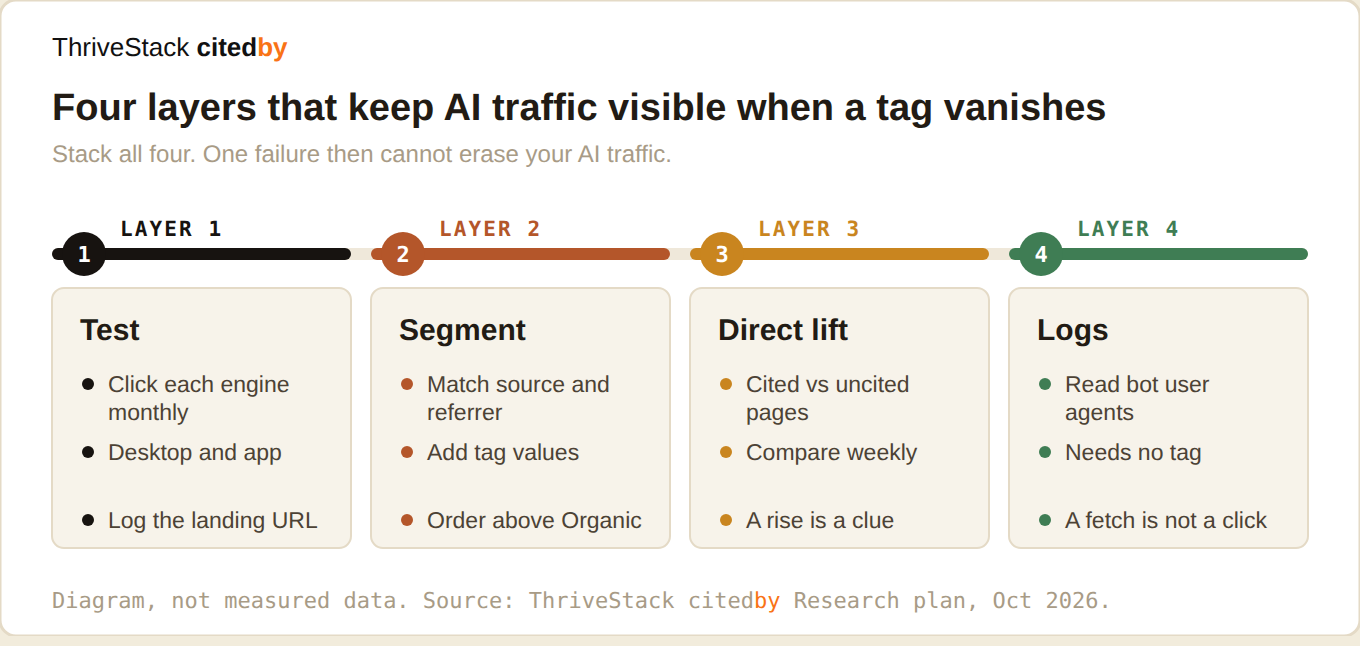
Four layers that survive a missing tag: test, segment, Direct lift and server logs. Diagram, not measured data.