
Mastering AI Visibility:
Applying SEO, AEO, and GEO for the AI Search Era
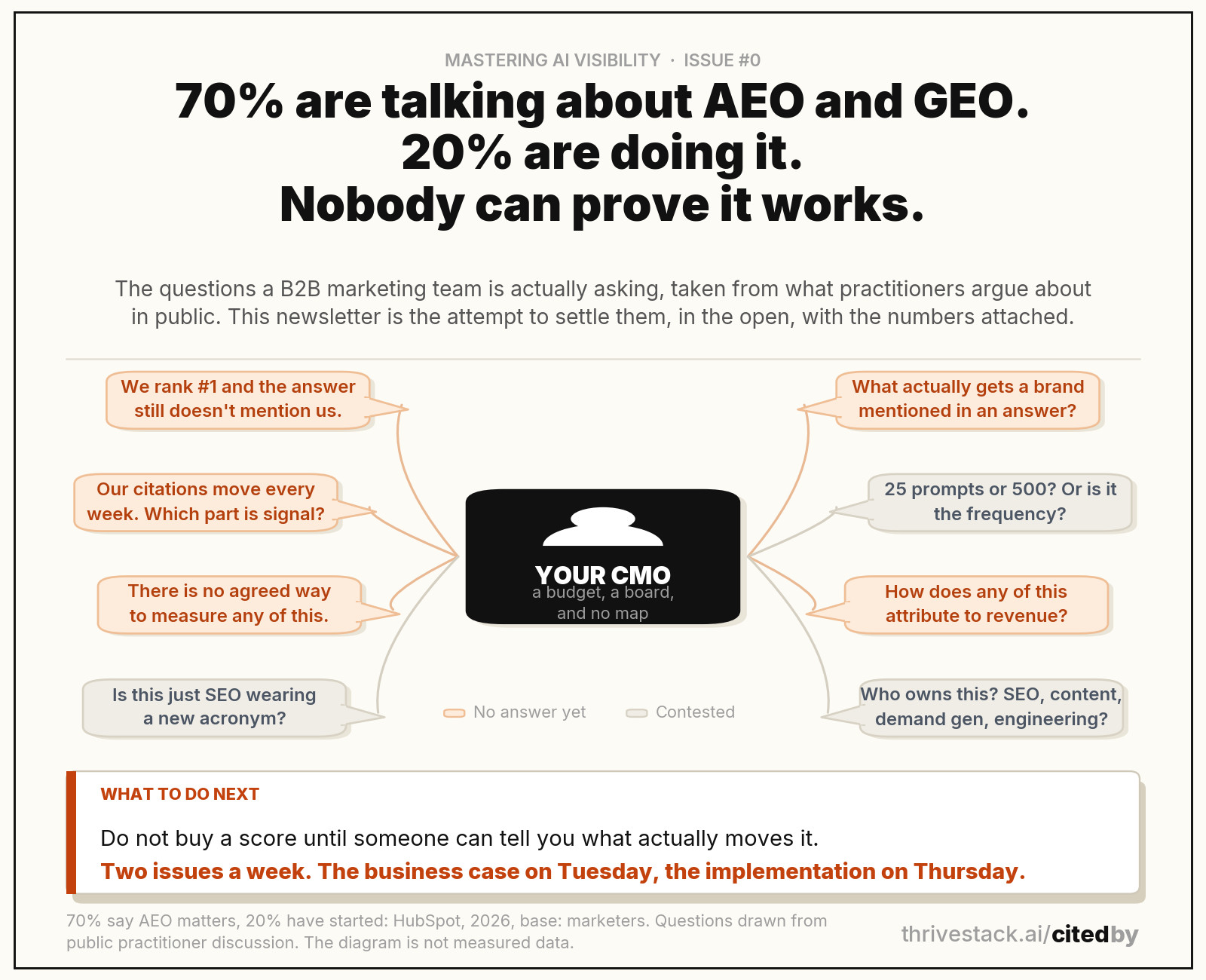
70% of marketers say AEO matters. 20% have started. (HubSpot, 2026, base: marketers.) The questions a marketing team is actually asking. Orange means nobody has a defensible answer yet. Grey means everyone has an answer and they contradict each other. Diagram, not measured data.
This newsletter exists to answer one question: is AI visibility a real channel, or is it snake oil?
We do not know yet. That is the honest starting position, and it is why we are writing this. A whole industry has appeared in about eighteen months, selling scores, dashboards and playbooks for a discipline nobody has run a controlled experiment on. Some of it is going to turn out to be load-bearing. Some of it is going to turn out to be a dashboard you paid for and stopped opening.
Our job is to work out which is which, in public, with the numbers attached.
Here is what that means in practice.
- Two issues a week, and they do different jobs. Tuesday is the business case: what this does to pipeline, what it costs, what a CMO can defend in a budget meeting. Thursday is the technical implementation: the schema, the crawlers, the prompt set, the code. Both halves, across the whole AEO and GEO spectrum, because a strategy nobody can ship is a slide.
- Operators, not vendors. We will bring in the people who have actually done this: CMOs who ran the programme, the ones who saw ROI, and the ones who did not and can say why. A case study without a control group is marketing, and we will say so when we see one.
- Every number carries its source and its base. If a claim has no sample behind it, it does not go in. When two studies disagree, we print both and name the conflict rather than picking the flattering one.
- We will contradict ourselves, on purpose. When the evidence turns, the newsletter turns with it, and we will point at the issue we got wrong. That has already happened once, in issue 16.
One more thing worth saying out loud. This is published by citedby, and citedby sells software in this category. So treat everything here the way we are asking you to treat everyone else in it: check the base, check who paid for the study, and believe the trend line over the headline. Where our own data appears, it is labelled as ours.
If it turns out to be snake oil, you will read that here first.
The eight questions this newsletter is trying to settle
Eight questions, taken from what practitioners are actually arguing about in public. Five of them nobody has a defensible answer to. Three of them everybody has an answer to, and the answers contradict each other. Here is where each one stands today, and which issue goes after it.
We rank #1 and the answer still does not mention us. Why?
Ranking is the entry fee, not the prize. Roughly 76% of AI citations come from pages already in Google's top 10, so you cannot skip SEO. But being in the top 10 is clearly not sufficient, and nobody has cleanly separated what the extra ingredient is. The strongest published signal is not on your page at all: Ahrefs looked at 75,000 brands and found branded web mentions correlate 0.664 with AI Overview appearances, against 0.218 for backlinks.
Our citations move every week. Which part of that is signal?
This is the single most common complaint from people actually running a programme, and it has no good answer yet. Engines re-rank, re-crawl and re-personalise constantly, so a week-on-week swing can mean your content moved, or it can mean nothing at all. Until somebody publishes a study on citation volatility with a control, treat any single reading as noise and watch only the trend.
There is no agreed way to measure any of this.
Correct, and it is worse than it looks. Four published studies measured the same thing, how much better AI-sourced traffic converts than organic, and got 4.4x, 5.1x, 8.3x and 23x. Two of them never published a base. The industry is quoting each other's numbers without checking who was measured. Your own baseline is the only benchmark you can trust.
What actually gets a brand mentioned in an answer?
NP Digital scored seven trust signals across the engines. Expert authorship came top at 4.0 to 4.6. Structured data came last. That is the opposite of what most of the AEO advice on the internet will tell you, and it is why we lead the schema issue with the finding that undermines it. AirOps puts 85% of citations on third-party domains and only 13% on brand-owned pages, which means most of the work is not on your website.
How does any of this attribute to revenue?
Badly, and mostly by accident. Most engines strip the referrer when a user moves from the app to a browser, so AI-sourced sessions land in Direct and your analytics quietly under-reports the channel. The honest fix is unglamorous: a self-reported "how did you first hear about us?" field on the demo form, and a first-touch field in the CRM. Everything else is inference.
25 prompts or 500? Or is it the frequency that matters?
Nobody agrees, and the spread is not small. Published guidance ranges from 25 prompts to 200+ depending on who is selling you the tool. Worse, most teams track only "best [category]" prompts, which is one stage of a five-stage buying journey, and then wonder why the number does not move. Nobody has run the experiment that would settle it.
Is this just SEO wearing a new acronym?
Three companies published their best arguments for AEO, GEO and AI SEO side by side, and then asked the engines to adjudicate. ChatGPT picked GEO. Perplexity picked AI SEO. Gemini picked AEO. The tools you are optimising for cannot agree on the name of the thing you do to optimise for them. Our position: they describe three different jobs, and they stack.
Who owns this? SEO, content, demand gen, or engineering?
It lands on whoever is nearest, which is usually SEO, and that is usually wrong. The work splits across four desks: crawlability and rendering sit with engineering, extractability with content, third-party corroboration with PR and demand gen, and the reporting with whoever has to defend the budget. A programme owned by one team fails at the handoffs it cannot see.
If you think any of these is already settled, we would like to be corrected, publicly. That is what the fifteen minutes below is for.
Have you run this and measured it?
This newsletter is trying to work out whether AI visibility is a real channel or an expensive story. That gets settled by operators, not vendors. If you have run a programme and have numbers, good or bad, we want the case study. The ones that did not work are worth as much as the ones that did.
Book 15 minutes →A 15-minute walkthrough, no pitch. cal.com/thrivestack/citedby-ai-visibility