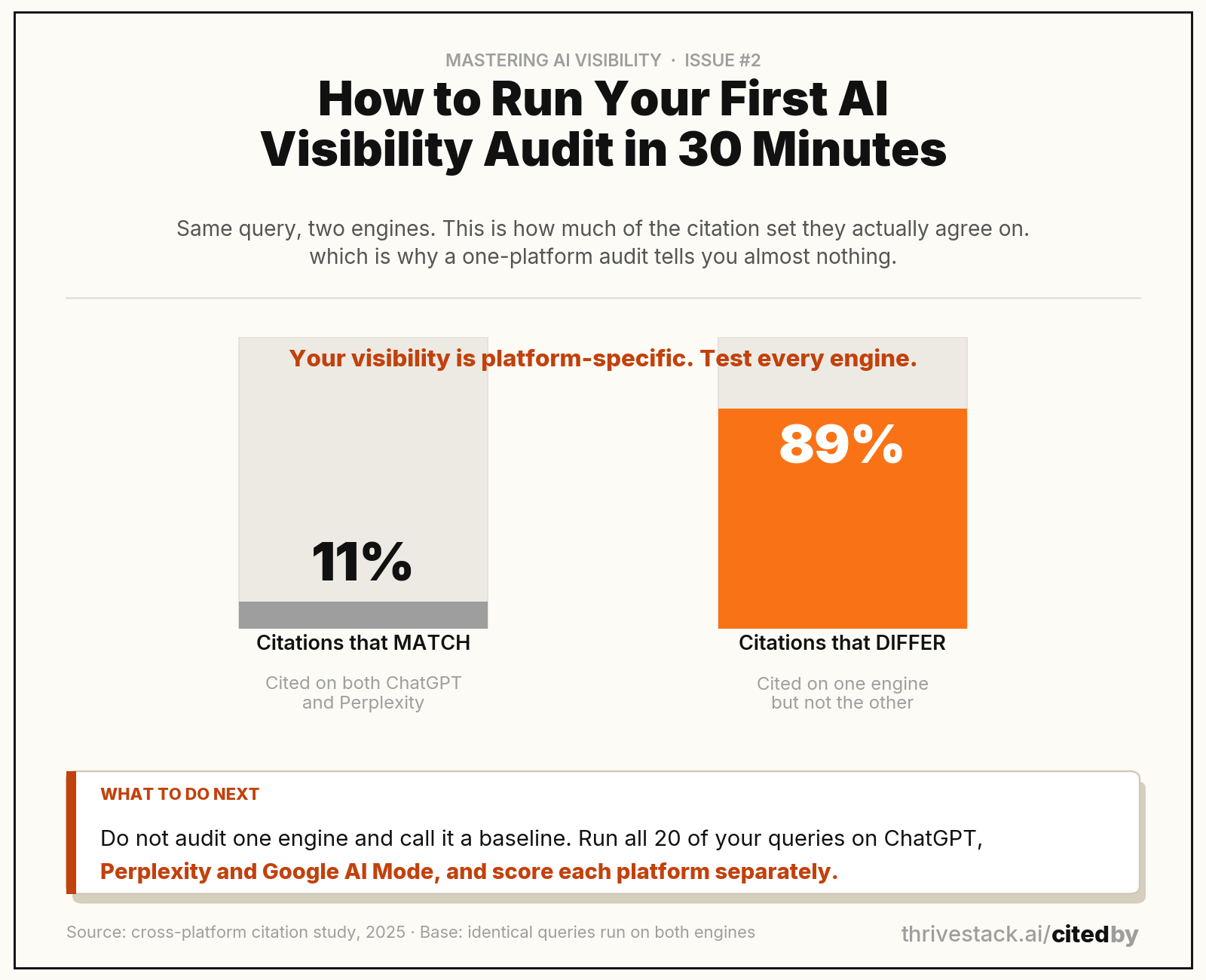
Before you can improve your AI visibility, you need to know where you stand. The baseline audit takes 30 minutes, uses only free tools, and produces a document you can use to brief your entire team on your current AI citation state. This is the starting point everything else builds on. The audit has three parts: a query inventory, a citation test, and a scoring pass. By the end, you will have a number. Your AI Share of Voice baseline, and a prioritized list of gaps to close. The 10-Step Audit Process1 | Define your 20 target queries List the 20 questions your buyers most commonly ask at the research stage of their journey. These should be the queries that, if answered with your brand cited, would put you in the consideration set. Include: category-level questions ("best [your category] for [your ICP]"), problem-specific questions ("how to [solve core problem]"), and comparison questions ("[your category] alternatives"). Write them exactly as a buyer would type or speak them — conversational language, not keyword-optimized phrases. |
2 | Set up your tracking spreadsheet Create a Google Sheet or Excel file with columns for: Query · Platform · Brand Cited? (Y/N) · Position (1st, 2nd, 3rd, or not cited) · Description Accuracy (Accurate/Partially/Inaccurate) · Competitor Citations · Date. You will fill this in with every test you run. It becomes your weekly AI visibility scorecard. |
3 | Run each query on ChatGPT Open ChatGPT (free or Plus). Run each of your 20 queries. For each response, record: Is your brand cited? (Y/N) · How prominent is the mention? (First mention, buried in list, or absent) · How does the AI describe your brand? Copy the exact language — AI descriptions often reveal how your brand is understood vs. How you want it to be understood · Which competitors are cited and in what position? |
4 | Run the same queries on Perplexity Perplexity is critical because it always shows its sources — you can see exactly which pages it is pulling from to construct its answers. This makes it the most auditable platform for identifying which of your pages (or competitors' pages) are driving citations. Run all 20 queries and record results in the same spreadsheet, in the Perplexity column. |
5 | Run the same queries on Google AI Mode Open Google and enable AI Mode (or use AI Overviews if AI Mode is not available in your region). Run all 20 queries. Google AI Mode integrates with the Google index, so citation patterns here often reflect your traditional SEO position — but filtered through a quality and answer-density layer. Record results alongside your ChatGPT and Perplexity data. |
6 | Calculate your AI Share of Voice per platform For each platform, count: (Total queries where your brand is cited) / (Total queries run) = AI Share of Voice %. A score of 3/20 = 15% AI Share of Voice on that platform. This is your baseline number. Write it down. It will be the benchmark against which every optimization you make is measured. |
7 | Flag every inaccuracy in brand descriptions Go through every response where your brand was cited. For each one, ask: Is the description of our product accurate? Is the use case description correct? Are the named capabilities current? Is the price point or tier description accurate? Flag every inaccuracy in a separate "AI Brand Accuracy" tab. These inaccuracies require proactive content published to correct them — a topic we'll cover in later issues. |
8 | Identify the top 5 competitor citations Across all 20 queries on all 3 platforms, which competitor brands appear most frequently? In what position? With what description? This competitor citation map tells you who owns AI Share of Voice in your category right now — and which competitors' content strategies you should study most carefully. Note the pages Perplexity is citing for each competitor. |
9 | Check your own pages' performance For each query where a competitor was cited on Perplexity, click the source link and look at the cited page. Ask: Does your brand have a page that answers the same question? If yes — why is theirs being cited and not yours? Compare answer density (do they answer in the first 150 words?), content completeness (do they address more sub-aspects?), and structure (do they use clear headers and direct answers?). These are your restructuring priorities. |
10 | Create your baseline summary document Compile the audit into a one-page summary: (1) Your AI Share of Voice baseline per platform. (2) Top 3 accuracy issues to correct. (3) Top 5 queries where competitors are cited and you are not. (4) Top 3 content restructuring priorities. This document is your AI visibility program brief — the foundation of every action you take from here. |
Your Tracking Spreadsheet TemplateCopy this structure into a Google Sheet. Run it weekly. The baseline matters less than the trajectory. Week-over-week improvement is the signal that your optimizations are working. AI VISIBILITY TRACKER — Weekly Log --------------------------------------------------------------------- Query | Platform | Cited? | Position | Accuracy | Competitors --------------------------------------------------------------------- [Query 1] | ChatGPT | Y | 1st | Accurate | Brand B, Brand C [Query 1] | Perplexity | N | — | — | Brand B, Brand D [Query 1] | Google AI | Y | 2nd | Partial | Brand B [Query 2] | ChatGPT | N | — | — | Brand C --------------------------------------------------------------------- SUMMARY ROW: AI Share of Voice this week: ChatGPT __% | Perplexity __% | Google AI __% "Your site's technical foundations decide your visibility in AI search."  | Aleyda Solís Orainti · on AI search crawlability |
Source: Humans of Martech, ep. 202, Jan 2026 This Week's Fix Build your 20-query tracking spreadsheet. Run your first test this week across ChatGPT, Perplexity, and Google AI Mode. Record your baseline AI Share of Voice number. The score doesn't matter yet — having the baseline does. Every optimization you make from here will be measured against this week's number. Frequently Asked QuestionsWhat if my AI Share of Voice is 0% across all platforms?That's the most actionable starting point. It means your content is either not crawlable by AI bots (check Week 2's technical audit), not structured for citation (covered in Weeks 4 and 7), or not building enough third-party corroboration (covered in Week 9). Zero is not failure. It's a clear brief. Do I need to test all AI platforms, or just one?Test at least 3. ChatGPT, Perplexity, and Google AI Mode cover the platforms your B2B buyers are most likely using. Research shows that 89% of citations differ between ChatGPT and Perplexity on the same query, so your visibility profile is platform-specific. Testing one gives you a partial picture. How often should I run this audit?Weekly for the first 90 days. You need to establish a trend line and see whether your optimizations are working. Monthly after that, unless you're in an active optimization sprint. The weekly test takes 20 minutes once the spreadsheet is set up. What's a good AI Share of Voice score for my category?It varies significantly by category and competitive intensity. For most B2B software categories, a score above 40% on your top 20 queries, across at least two platforms, is a strong position. A score below 10% means you are largely absent from the conversations that precede your pipeline. Benchmark against the 3-5 competitors you see most in Perplexity source citations. |