

In partnership with

100+ ChatGPT Prompts to Revolutionize Your Day

Supercharge your productivity with HubSpot's comprehensive guide to Chat GPT. This free resource is your fast track to AI mastery:
Industry-Specific Use Cases: 15+ real-world applications across various sectors
Productivity Guide: 21 best practices to 10x your efficiency with AI
Prompt Powerhouse: 100+ ready-to-use prompts for immediate implementation
Challenge Buster: Overcome common AI hurdles with expert strategies
Plus, in-depth sections on email composition, content creation, customer support, and data analysis.
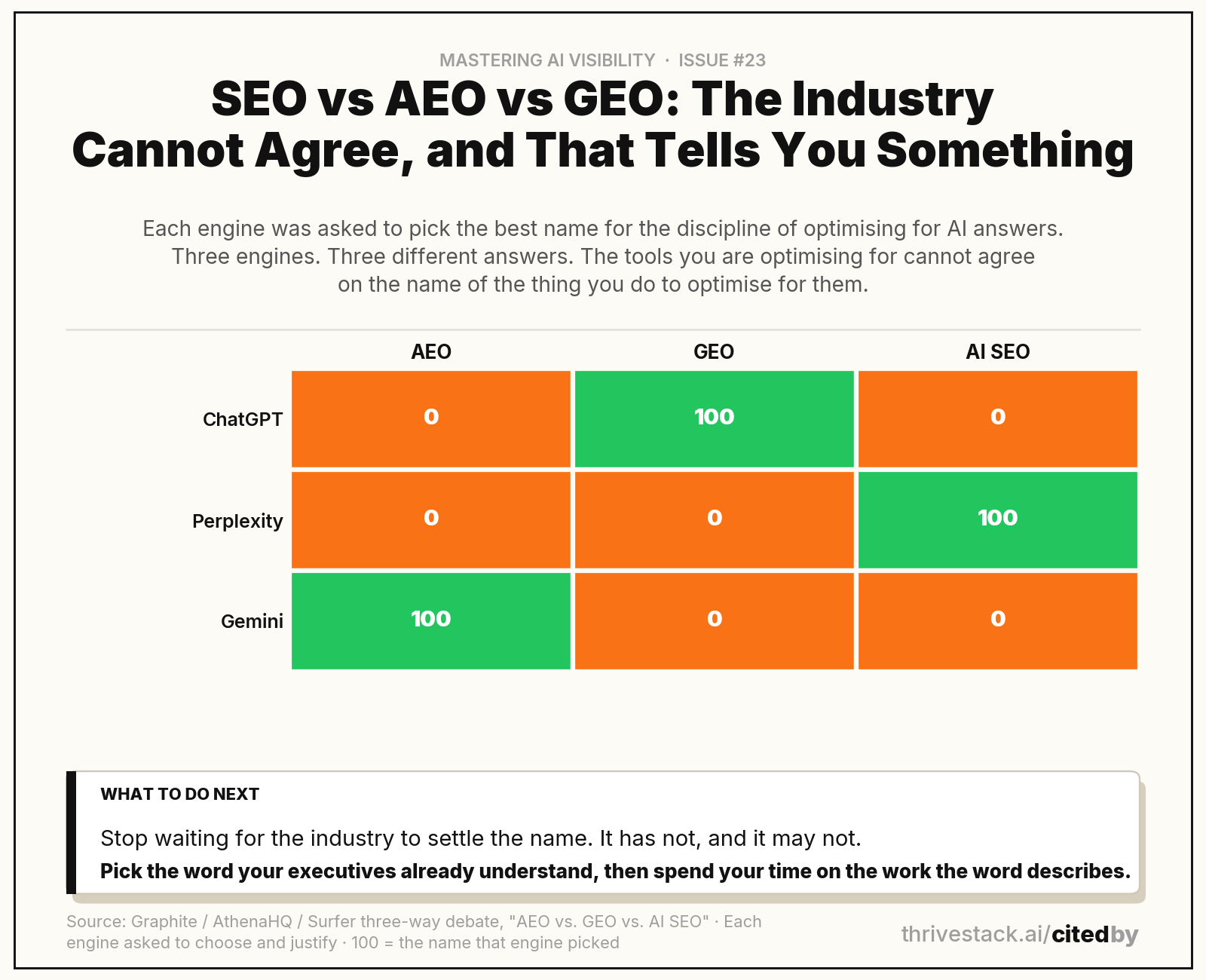
Three AI engines were asked what to call the practice of optimising for AI engines. They gave three different answers. ChatGPT said GEO. Perplexity said AI SEO. Gemini said AEO.
That is funny. It is also the most useful thing you will read about this today. The tools you are trying to appear inside cannot agree on the name of the thing you do to appear inside them. So when a vendor tells you the distinction between SEO, AEO and GEO is settled, they are not reporting a fact. They are selling you a vocabulary.
This issue lays out the three strongest published arguments, names the people making them, and then tells you which parts actually change your Monday.
There is no consensus. Plan your work as if there will not be one.
The debate, and who is making it
In 2026 three companies did something unusual. Graphite, AthenaHQ and Surfer each put forward their best argument for a different name, published all three side by side, and invited people to vote. It is the clearest single artefact in this argument, so we will use their words rather than paraphrase them.
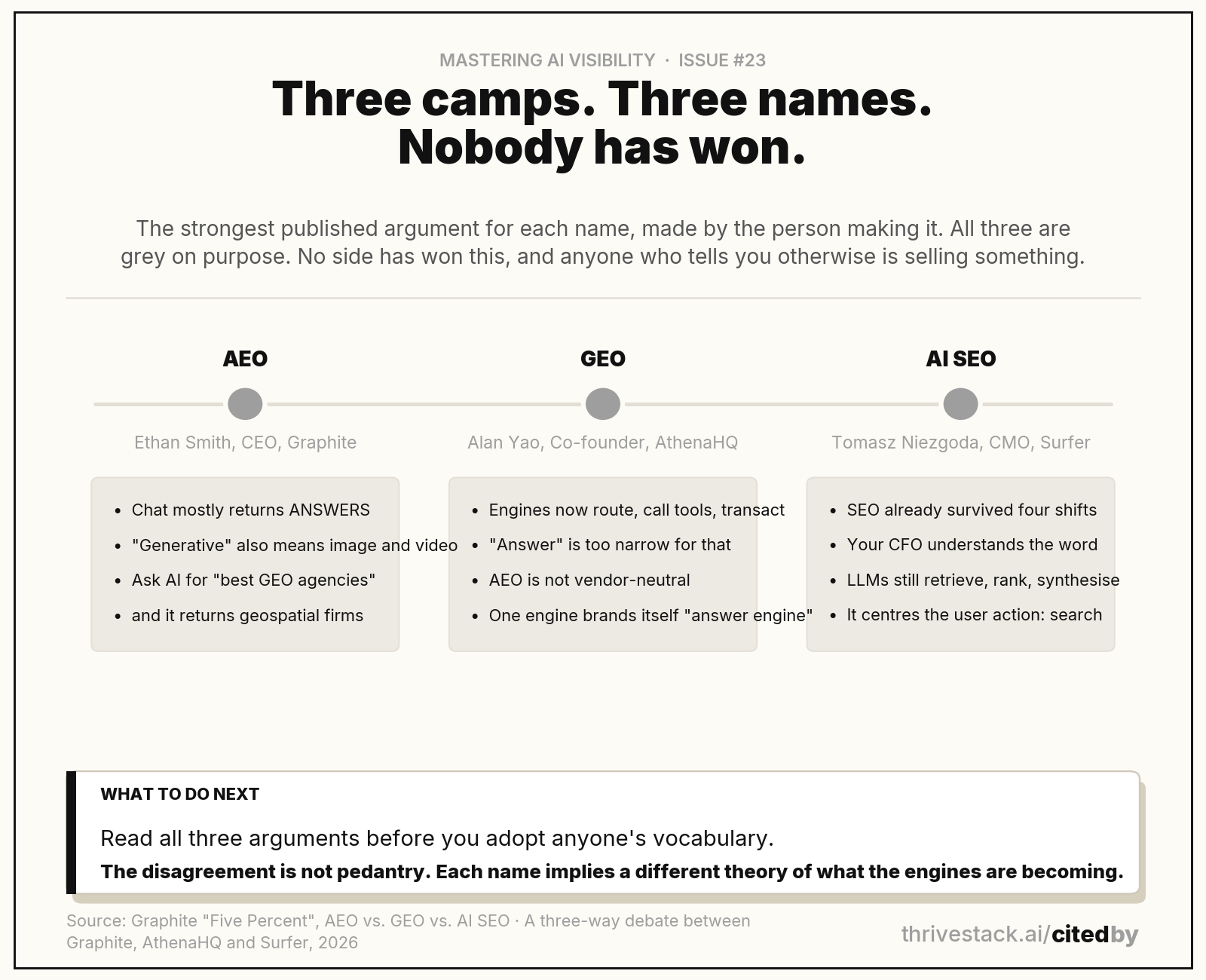
The three published positions. All three are grey because none of them has won. Source: Graphite "Five Percent", AEO vs. GEO vs. AI SEO.
The case for AEO: chat returns answers
The argument is about precision. Chat is mostly a question and an answer. "Generative" is a much bigger tent that also covers image, video and world generation, and those will be separate disciplines with separate playbooks.
His sharpest point is empirical. Ask an engine for the best GEO agencies and it returns geospatial mapping firms. The word is already taken.
The case for GEO: answers are only the beginning
This is the argument that actually worries us, because it is a claim about direction rather than vocabulary. If engines are becoming things that book, buy and call APIs on a buyer's behalf, then optimising to be quoted in a paragraph is a small part of the job. You will also be optimising to be the tool the engine picks up.
And the neutrality objection lands. One major engine markets itself as "the answer engine". Naming the whole field after one company's positioning is a real problem, whatever you think of the rest.
The case for AI SEO: your CFO already understands the word
The continuity argument is the strongest one for anybody who has to get a budget approved. SEO has already survived directories, keywords, mobile and voice. Calling this the next phase of a discipline your leadership already funds is easier than asking them to fund a new acronym.
The counter is that AI SEO is ambiguous in a way the others are not. Half the market hears "AI SEO" and thinks you mean using AI to do SEO faster, which is a completely different activity.
Do not settle this with search volume
One popular argument runs: AI SEO has hundreds of thousands of searches a month, GEO and AEO have very few, so the market has decided. Be careful. We pulled the numbers ourselves and they do not mean what they appear to mean.
aeo shows roughly 27,100 searches a month at a keyword difficulty of 49. No emerging marketing discipline has that profile. AEO is the stock ticker of a large clothing retailer. Search the unambiguous phrase instead, answer engine optimization, and the volume drops to about 2,400. The same contamination hits GEO, which belongs to geospatial.
So the acronym volumes are measuring retail investors and map software, not marketers. Judge these names by what they make you do, not by a number that is counting somebody else.
The unambiguous phrase, “answer engine optimization”, gets 2,400.
Our position: three names, three jobs, and they stack
Here is the part that survives the argument. Strip the branding and the three words describe three different questions, and they happen in order.
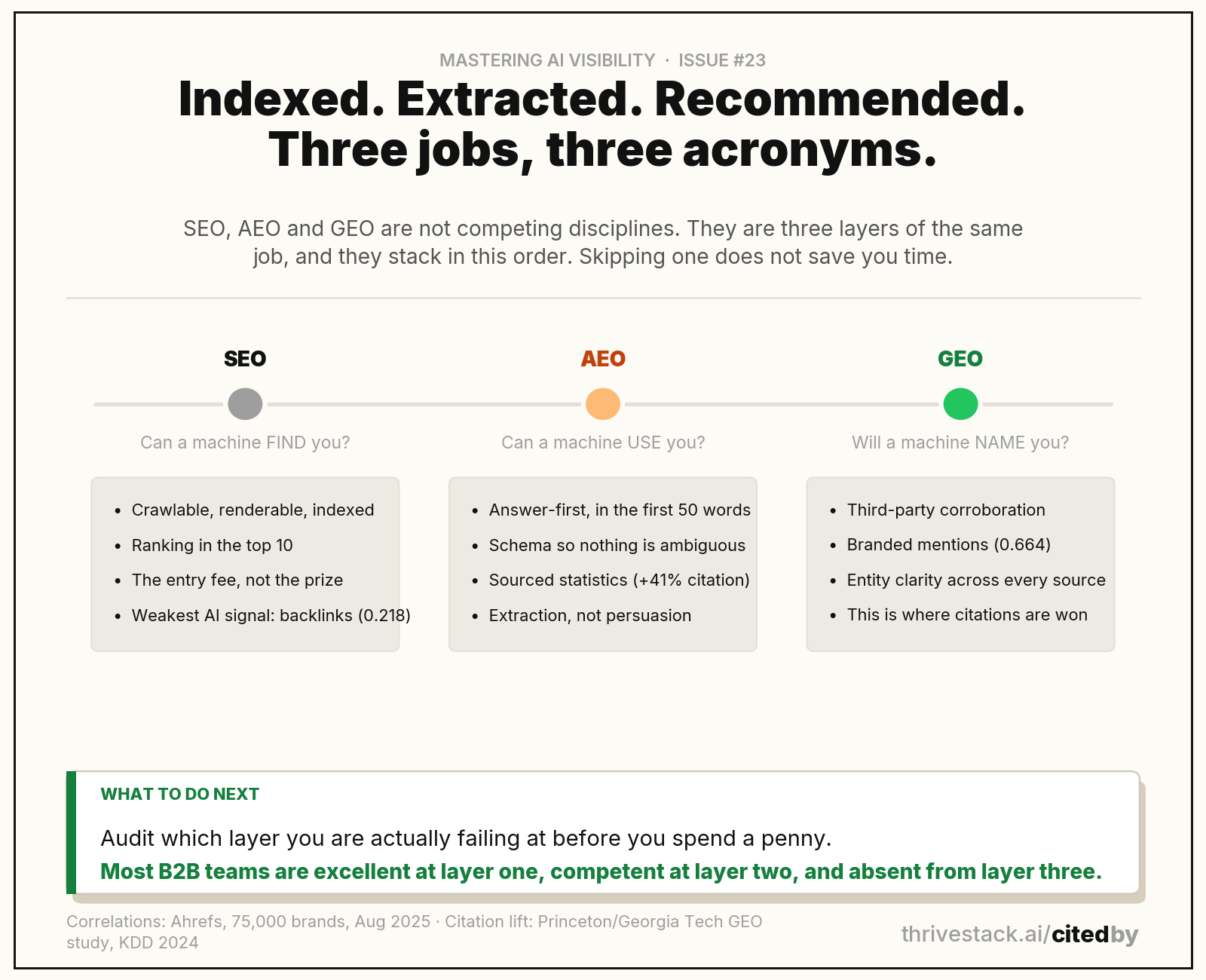
The three layers, in the order they gate each other. Correlations: Ahrefs, 75,000 brands. Citation lift: Princeton/Georgia Tech GEO study, KDD 2024.
Can a machine find you? That is SEO. Crawlable, rendered, indexed, ranking. It is the entry fee. Around 76% of AI citations come from pages already in Google's top 10, so this layer still gates everything above it.
Can a machine use you? That is AEO. Answer-first writing, schema, sourced statistics, claims an engine can lift without interpreting. The Princeton and Georgia Tech GEO study found statistics lift citation visibility by 41% and quotations by 37%.
Will a machine name you? That is GEO. Third-party corroboration, entity clarity, branded mentions across sources you do not own. Ahrefs found branded web mentions correlate 0.664 with AI Overview appearances. Backlinks score 0.218. That gap is the whole reason this third layer exists.
Most B2B teams are excellent at the first layer, competent at the second, and completely absent from the third. That is the finding. It does not depend on which acronym you prefer.
Frequently Asked Questions
What is the difference between AEO and GEO?
Is AEO or GEO replacing SEO?
Should I call it AEO, GEO or AI SEO?
Does search volume prove which term is winning?
Which layer should I fix first?
Have you run this and measured it?
This newsletter is trying to work out whether AI visibility is a real channel or an expensive story. That gets settled by operators, not vendors. If you have run a programme and have numbers, good or bad, we want the case study. The ones that did not work are worth as much as the ones that did.
Book 15 minutes →A 15-minute walkthrough, no pitch. cal.com/thrivestack/citedby-ai-visibility