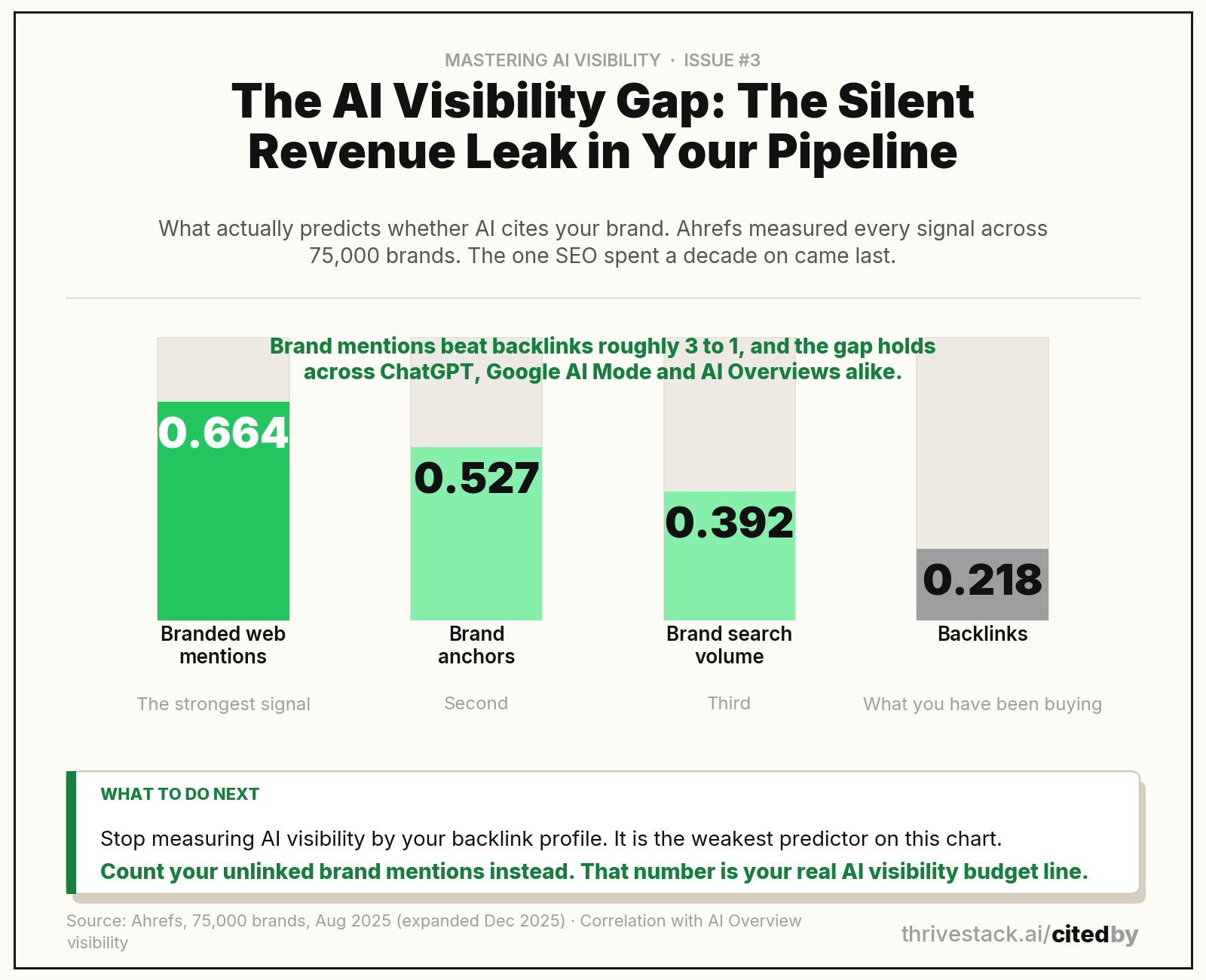
Your AI visibility is the share of your buyers' questions where an AI names your brand. Most B2B companies have never measured it once. The gap between your search presence and your AI presence is the AI Visibility Gap, and it leaks revenue quietly, before your funnel starts. You have two presences online. The first one you know well. Rankings, sessions, backlinks, a dashboard you have watched for years. The second is newer. It is how often AI tools name you, and how accurately they describe you, when a buyer asks the question that starts a purchase. A ranking drop sets off an alarm. This does not. There is no alert, no dashboard, no traffic dip to point at. Pipeline just softens over a couple of quarters and nobody can say why. 0.664 Correlation between branded web mentions and AI Overview visibility.
Backlinks manage 0.218. Ahrefs · 75,000 brands · Aug 2025, expanded Dec 2025 The signal you have been buying is the weakest oneAhrefs measured which signals predict whether AI cites a brand. They studied 75,000 of them. The winner was branded web mentions at 0.664. Backlinks came last at 0.218. Read that again. The thing SEO teams have spent a decade and most of their budget on is the weakest predictor on the list. Brand anchors scored 0.527. Brand search volume scored 0.392. The top three are all off-site, and none of them is a link you can buy. The gap held across ChatGPT, Google AI Mode and AI Overviews. This is not a quirk of one engine. It is how the machines decide who to trust. That is the mechanism. An AI naming you is making a bet on its own reputation. It does not take that bet on the strength of your backlink profile. It takes it because the open web keeps corroborating what you say about yourself. Why AI visibility is a pipeline problem, not an SEO problemForrester found that 61% of the B2B buying decision is done before a vendor is contacted. That decision now forms inside AI tools. So when a buyer asks which platforms are best for their use case, and your name is not in the answer, you did not lose a deal. You never entered one. No form fill, no site visit, no CRM record. Nothing to review in the pipeline meeting. There is a second failure mode, and it is worse. Sometimes AI does name you, and gets you wrong. Old pricing. A product you retired. A capability you never had. Models train on historical data and refresh on their own schedule. Without a deliberate effort to feed them accurate information, buyers meet a version of your company that no longer exists. Three things set the size of your gap1 | Completeness. Does your site actually answer the buyer's question, in full, on the page? Not gesture at it. Not build up to it. Answer it. If the answer is not extractable, it cannot be cited. |
2 | Corroboration. Does anyone else on the open web confirm what you claim? This is the 0.664. Your own claims about yourself have a ceiling. Third parties raise it. |
3 | Entity clarity. Is there enough consistent, structured data for a machine to know what you are? One canonical description, used everywhere. Same name, same category, same claims. Consistency is the signal. |
Most B2B brands are underinvested in all three, relative to what they spend on SEO. That imbalance is the gap. Your gap is a profile, not a numberChatGPT, Perplexity, Gemini and Copilot do not draw on the same sources in the same proportions. You can be well cited on one and invisible on another for the same question. So there is no single AI visibility score. There is a profile across the engines your buyers actually use, and you have to test each one. Source: Kalicube, The Kalicube Framework "The brands it didn't recommend lost. Not because they weren't good, but because the AI didn't trust them enough to stake its credibility on them."  | Jason Barnard Kalicube · on the Zero-Sum Moment |
Source: Kalicube, The Kalicube Framework This week's fix Open ChatGPT, Perplexity and Google AI Mode. Ask each one: "Who is [your company] and what do they do?" Then: "What are the top [your category] platforms for [your ICP]?" Write down every inaccuracy and every competitor named ahead of you. That is your first AI Visibility Gap baseline. It takes ten minutes and you will not enjoy it. Frequently Asked QuestionsWhat is AI visibility?AI visibility is the share of your target buyer questions where an AI names your brand in its answer. It is measured across a defined query set, scored by how often you are cited and how prominently, on each engine separately. It is not the same as your search ranking, and one does not guarantee the other. Where does ChatGPT get its information about my company?From two places. Its training data, which is a snapshot of the open web at the time the model was built, and live retrieval, which fetches pages at the moment of the question. Both lean heavily on third-party sources: review platforms, community threads, industry press, directories. Your own website is one input among many, and rarely the decisive one. If my SEO rankings are strong, is my AI visibility strong too?Not automatically. Brands ranked third to eighth on Google routinely beat the number one result on citation frequency, because they have more complete content, more third-party mentions, or a cleaner entity definition. SEO rank is an input to AI visibility. It is not a proxy for it. How do I rank in AI Overviews?Start with the correlations rather than the folklore. Branded web mentions predict AI Overview visibility at 0.664; backlinks at 0.218. So the work is earning mentions across the open web, answering the question directly on the page, and keeping your entity data consistent everywhere it appears. Link building alone will not do it. Which AI tool should I check first?ChatGPT, for reach. Then Perplexity, because it always shows its sources and you can see exactly which pages it drew from. Then Google AI Mode, because it sits inside the search experience your buyers are already in. Can AI say wrong things about my brand that I cannot correct?Yes, and there is no support ticket for it. The only correction mechanism is publishing accurate, authoritative content that models can learn from, and getting third parties to repeat it. That takes months, not days. Which is why finding the inaccuracies early matters more than it looks. Be in the next issue Have you run this and measured it?This newsletter is trying to work out whether AI visibility is a real channel or an expensive story. That gets settled by operators, not vendors. If you have run a programme and have numbers, good or bad, we want the case study. The ones that did not work are worth as much as the ones that did. Book 15 minutes →A 15-minute walkthrough, no pitch. cal.com/thrivestack/citedby-ai-visibility |