
In partnership with

Keep up with marketing in 5 minutes

TLDR Marketing is the free daily email with summaries of the most interesting stories in growth, martech, and digital marketing. The tactics worth stealing, minus the digging through LinkedIn.
Every issue is curated by subject-matter experts and lands in your inbox before your morning coffee. A 5-minute read, and you walk into the day already knowing what your competitors are still figuring out.
We cover the channels that move your numbers: paid, SEO, email, social, and ecommerce. Whether you work in B2B or B2C, in-house or agency-side, pick the stories that match your work.
Free, daily, and read by 330K+ marketers. Subscribe for free and let someone else do the digging.
One session. Thirty pages. A refresh queue you can hand to a writer on Monday.
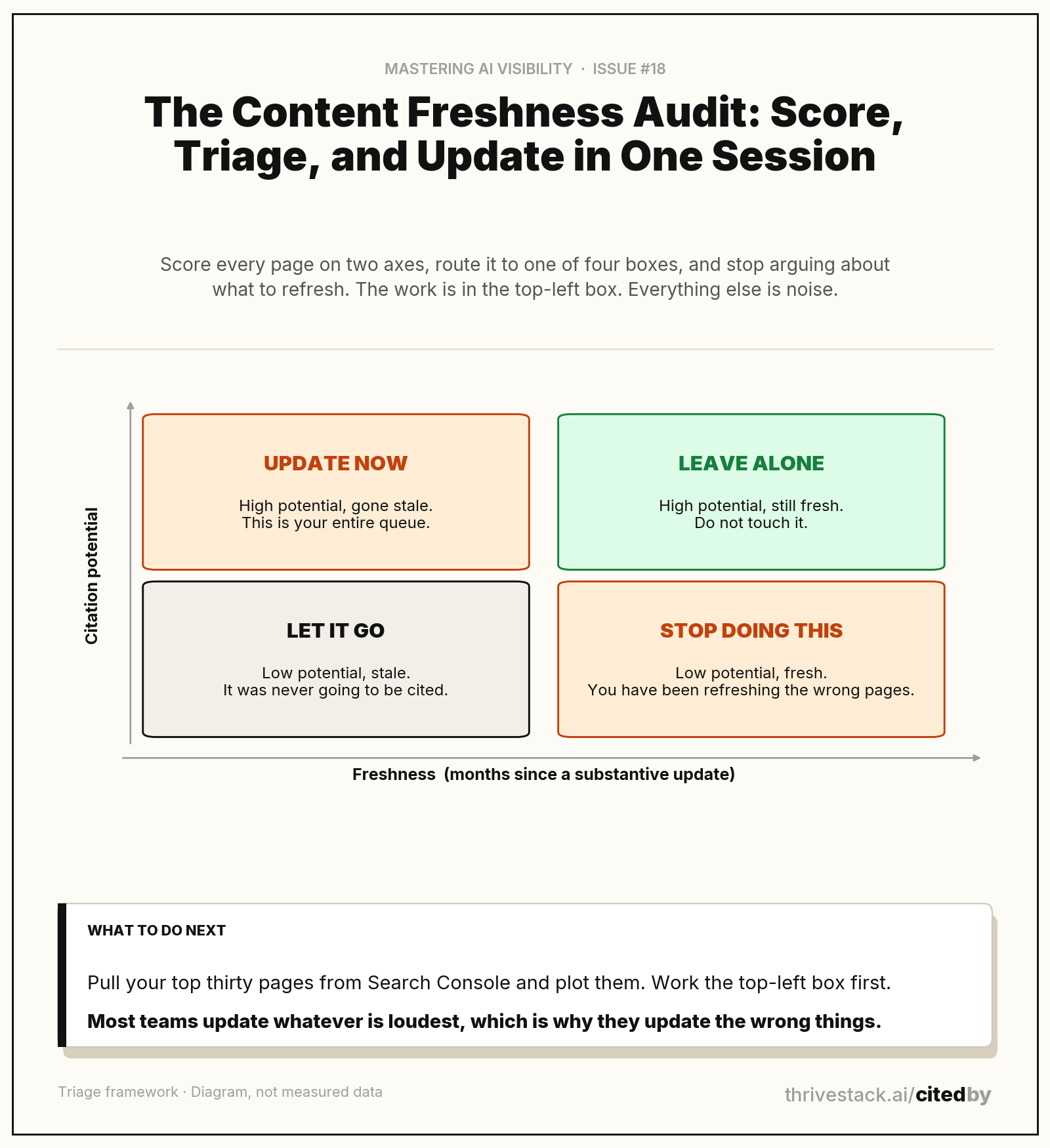
Issue #17 made the case: content untouched for twelve months loses roughly 60% of its citation probability. This is the operational answer. Score every page on two axes, route it to one of four actions, and stop having the same argument about what to update.
The two axes are citation potential and freshness. High potential and stale is your queue. High potential and fresh, leave alone. Low potential and stale, let it go. Low potential and fresh, you have been wasting effort and should stop.
Step 1: pull your top thirty pages
1 | AI Citation Potential (1–15 points) Five criteria, 1–3 points each. Query volume
for the topic (1=low, 3=high). Answer-first structure in opening paragraph (1=buried answer, 3=BLUF format). Schema markup deployed (1=none, 2=partial, 3=full). Statistics with cited sources (1=none, 2=some, 3=comprehensive). Content type. Comparison, how-to, or definition (1=generic, 3=high-intent buyer query). Total: 5–15. High potential = 11+. |
2 | Freshness (Fresh or Stale. Binary)
Fresh = last updated within 6 months AND has either a visible date OR dateModified in Article schema. Stale = last updated more than 6 months ago, OR no visible date anywhere on the page, OR dateModified not present in schema. If in doubt: treat as Stale. The threshold is strict. AI systems penalize undated content. |
Step 2 and 3: score, then route
1 | Replace at least one statistic with a 2025/2026 source Find the oldest statistic. Find a more recent version of the same data point (or a related one). Replace it. Update the in-text source citation. This is the substantive change that validates all other freshness updates. Do this first. |
2 | Update Article schema dateModified to today's date "dateModified": "2026-06-22" (ISO 8601 format). Do this last in your workflow. After making substantive content changes. Never change dateModified without a real content update: it's a bad-faith signal some systems detect. |
3 | Add or update the visible "Last updated" marker Add "Last updated: June 2026" as visible text at the top of the post. Visible text carries weight that CSS-hidden metadata does not. If your CMS template doesn't support this natively, add it inline in the content directly below the post title. |
4 | Add one new FAQ entry Add a Q&A to the FAQ section based on a question your sales team heard in the last 90 days. Phrase the question exactly as a buyer would ask AI: "What is [X] and who is it for?" This adds substantive content and extends the FAQPage schema simultaneously. Two freshness and citation signals in one edit. |
5 |
Add one internal link from a recent post Find a post published in the last 60 days. Add a contextual link to the page you just updated. This creates a fresh inbound link signal. Telling AI crawlers this older page is still being referenced by current content. Takes 3 minutes per link. |
The update checklist
When a page comes out of the queue, this is what a real refresh looks like. Anything less and you are changing the date, which we covered in Issue #17 and which does not work.
 | Kevin Indig Growth Memo · on content decay |