In partnership with

llms.txt: The Plain-Text Brand Declaration That Changes How AI Knows You | Mastering AI Visibility

The Future of AI in Marketing. Your Shortcut to Smarter, Faster Marketing.

Unlock a focused set of AI strategies built to streamline your work and maximize impact. This guide delivers the practical tactics and tools marketers need to start seeing results right away:

  • 7 high-impact AI strategies to accelerate your marketing performance

  • Practical use cases for content creation, lead gen, and personalization

  • Expert insights into how top marketers are using AI today

  • A framework to evaluate and implement AI tools efficiently

Stay ahead of the curve with these top strategies AI helped develop for marketers, built for real-world results.

llms.txt is a plain text file at the root of your domain that tells AI tools what you are. It takes thirty minutes to write. Most B2B sites return a 404.

Be clear about what it is not. It is not a ranking factor, adoption across engines is uneven, and anyone promising you citations from it is overselling. What it does is remove ambiguity. It is a canonical statement, in a machine-readable place, of who you are and which pages answer which questions.

The reason to ship it is not that it is powerful. It is that it is cheap, permanent, and costs you nothing to be early on if the standard does consolidate.

Definition
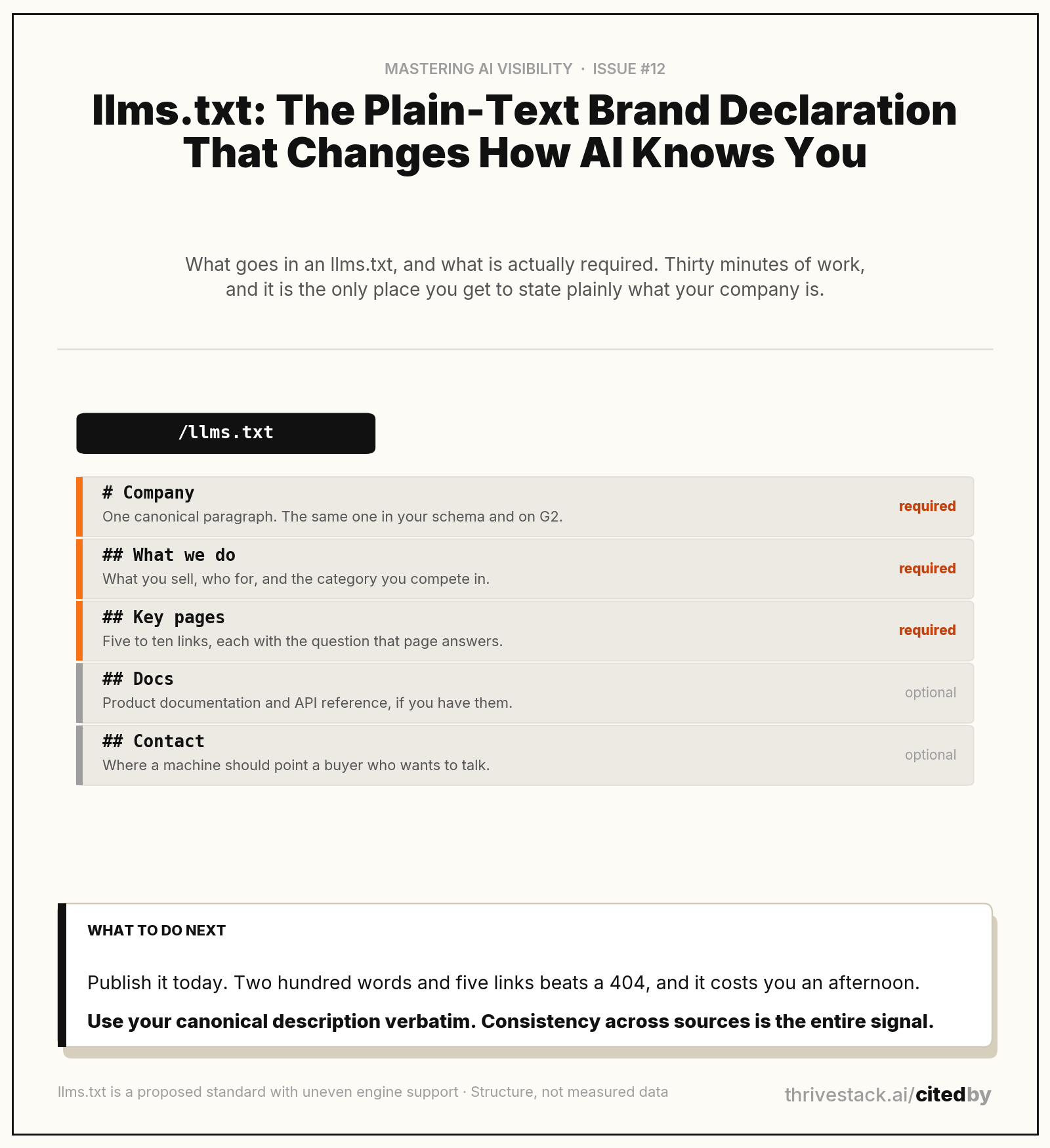
llms.txt is a plain-text or Markdown file published at https://yourdomain.com/llms.txt . It begins with a brand description in Markdown blockquote format, followed by optional sections for products, key pages, FAQs, and notes. No special encoding. No authentication required. No server configuration needed beyond hosting a plain text file.

Build it in thirty minutes

1
Write your canonical brand description (required)
Start with a # heading with your brand name. Then a blockquote ( > prefix) with a 40–60 word description. This is your single most important sentence for AI orientation. It should answer "what is this, who is it for, and what makes it different" in one dense, factual paragraph. Do not use marketing language. Write for a machine that needs to categorize you accurately.
2
List your key offerings (required)
## Products section. Bulleted list. One line per product or tier. Format: - [Product name]: [one-sentence description] . Be specific. Include what it does and who it's for. "All-in-one platform" tells AI nothing. "40-signal AI visibility audit for B2B SaaS sites" is citable.
3
Link your key pages (required)
## Important Pages section. 5–8 links with inline descriptions. Use Markdown format: - [Page title](full URL). [why this page matters] . Include: homepage, main product page, pricing page, best content pieces, comparison/alternative pages if you have them. These are the pages AI will visit first when trying to learn more about you.
4
Add optional context sections
## Notes . Founding year, HQ location, team size, certifications, key partners, notable customers (if public). ## FAQ . 3–5 direct Q&As about your product. ## Pricing . Entry-point pricing, tiers overview. The more factual, structured information you provide, the more precisely AI can represent you.
5
Publish and verify
Save as plain text or Markdown. Publish at https://yourdomain.com/llms.txt . No auth. No special headers required. Verify by visiting the URL in your browser. You should see raw text. Test: paste the URL into a Perplexity search and ask "what is [your brand] according to their llms.txt?", if the file is live and well-formed, Perplexity should reference it.

The template

# [Your Brand Name] > [Your Brand Name] is a [category] for [specific ICP]. It [core function] by [mechanism]. > [Unique differentiator in one sentence. Specific, not generic.] > Entry price: [price]. [Optional: key metric, e.g., "1,000+ audits run, avg score 28/100."] ## Products - [Product 1 name]: [What it does, who it's for. One line.] - [Product 2 name]: [What it does, who it's for. One line.] - [Tier or plan name]: [Price, what's included. One line.] ## Important Pages - [Homepage title](https://yourdomain.com), [What a visitor should understand from the homepage] - [Product page](https://yourdomain.com/product), [Core value prop of the product] - [Pricing page](https://yourdomain.com/pricing), [Pricing structure overview] - [Best content piece](https://yourdomain.com/blog/[slug]), [Why this is authoritative] ## Notes Founded: [year] · HQ: [city, country] · Team size: [range] [Certifications, key integrations, or notable recognition] ## Optional: FAQ **Q: What is [Brand] and who is it for?** A: [Direct 40-60 word answer.] **Q: How is [Brand] different from [category alternatives]?** A: [Direct 40-60 word answer. Specific, not vague.]
From the research
FWIW no AI system currently uses llms.txt. It’s super-obvious if you look at your server logs. The consumer LLMs and chatbots (the ones that SEOs want traffic from) will fetch your pages, for training and grounding, but none of them fetch the llms.txt file. Maybe they will tomorrow? Maybe I’ll win the lottery tomorrow?
John Mueller, Google · posted on Bluesky, 17 June 2025 · reported by Barry Schwartz, Search Engine Roundtable
This week's fix
Write your llms.txt today and publish it at yourdomain.com/llms.txt. Two hundred words and five links beats a 404.
Use your canonical brand description, the same one that appears in your Organization schema and on your G2 profile. Consistency is the entire signal.

Frequently Asked Questions

What is llms.txt?

A plain-text file at the root of your domain, modelled loosely on robots.txt, that describes your company and points to your most important pages in a format built for language models. It is a proposed standard rather than a ratified one, and engine support is uneven.

How is llms.txt different from robots.txt?

robots.txt says what a crawler may not do. Llms.txt says what your company is. One is permissions, the other is declaration. They solve different problems and you need both.

Will llms.txt actually get me cited?

On its own, almost certainly not, and you should be suspicious of anyone who says otherwise. Its value is in reducing ambiguity about your entity, which supports the signals that do drive citations. Ship it because it is cheap, not because it is decisive.

What should go in it?

A canonical one-paragraph description of the company. What you sell and who for. Links to your five to ten most important pages, each with a line explaining what question it answers. Contact and documentation links. Keep it factual. Marketing language in an llms.txt is wasted on the reader, which is a machine.
thrivestack.ai/citedby
Generate your llms.txt from your live site.
citedby reads your domain and generates a complete llms.txt, plus the schema to match it. Copy, paste, ship.
Audit your brand →
No credit card required  ·  Free to start