

In partnership with

100+ ChatGPT Prompts to Revolutionize Your Day

Supercharge your productivity with HubSpot's comprehensive guide to Chat GPT. This free resource is your fast track to AI mastery:
Industry-Specific Use Cases: 15+ real-world applications across various sectors
Productivity Guide: 21 best practices to 10x your efficiency with AI
Prompt Powerhouse: 100+ ready-to-use prompts for immediate implementation
Challenge Buster: Overcome common AI hurdles with expert strategies
Plus, in-depth sections on email composition, content creation, customer support, and data analysis.
Seven signals. Six engines. One grid that tells you what to do first.
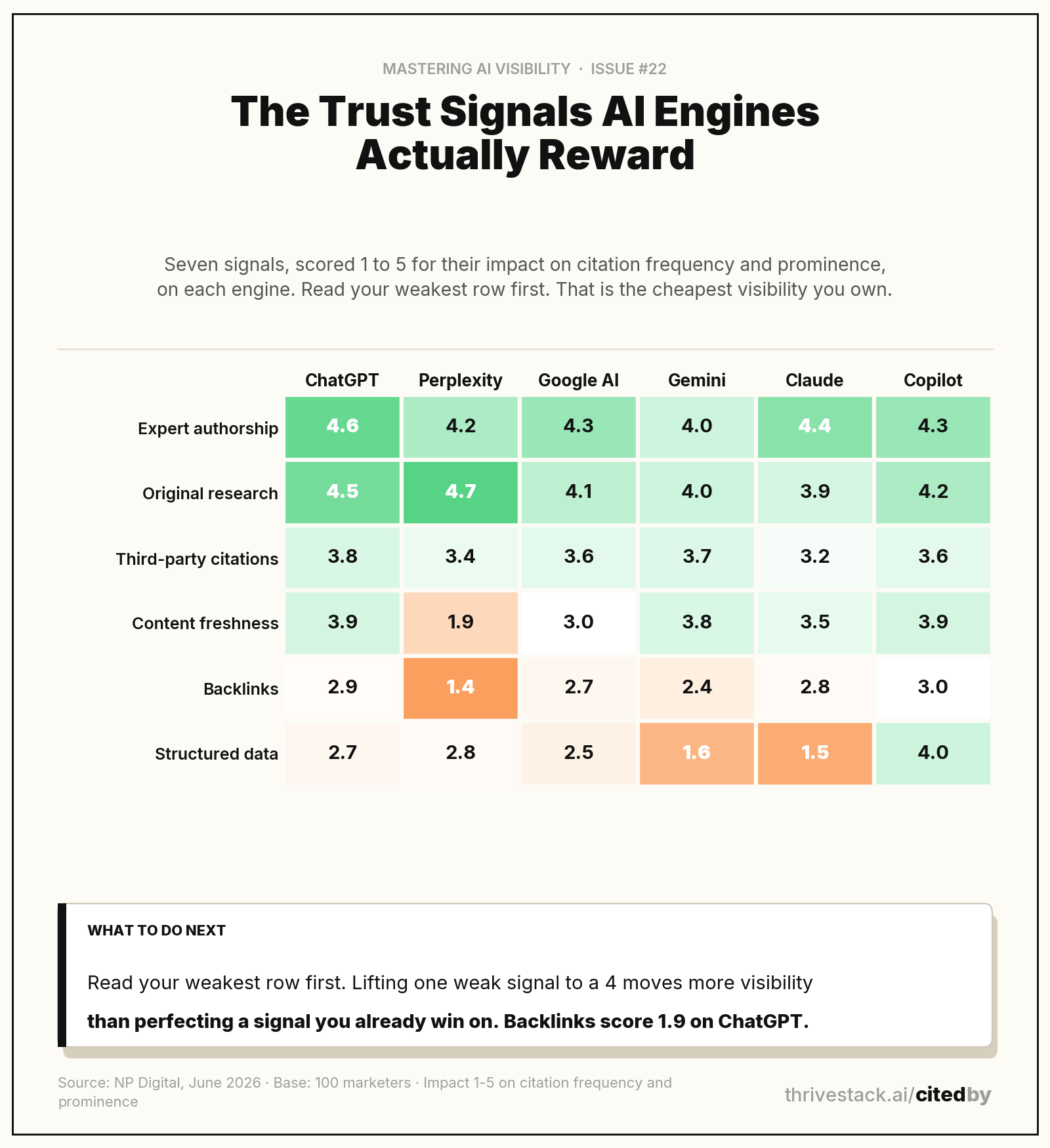
NP Digital scored each trust signal on its impact on AI citation frequency and brand prominence, engine by engine. The result is the closest thing this discipline has to a prioritisation map, and it says some uncomfortable things.
Third-party citations top almost every column, between 4.5 and 4.8. Structured data comes last, as low as 1.4 on ChatGPT. Backlinks, the thing most SEO budgets are still built around, score 1.9 on ChatGPT and 3.9 on Google AI Overview.
Highest and lowest scoring signals measured.
Read the grid by row, not by column
Your instinct will be to read down a column and optimise for one engine. Do not. Read across your own weakest row instead.
Lifting a signal you score 1.5 on up to a 4 moves far more visibility than perfecting a signal where you are already at 4.6. The grid is a triage tool, and triage means going to the worst wound first.
The three findings that should change your plan
Backlinks are not a general-purpose signal any more. 3.9 on Google AI Overview, 1.9 on ChatGPT. If your AEO plan is a link-building plan with a new name, it is optimising for one engine and ignoring the largest one.
Structured data is table stakes, not strategy. Nothing above 3.0 on any engine. Ship it in an afternoon, as Issue #8 argues, then stop and go do the off-site work.
Community engagement is wildly engine-specific. 4.0 on Perplexity, 1.5 on Claude. A single blended AEO strategy will systematically under-serve whichever engine your buyers actually use.
Scoring yourself against the grid
Take the seven rows. Score your own brand one to five on each, honestly. Third-party citations: how many independent domains have written about you in the last year? Expert authors: do your articles carry named authors with real credentials and entity records? Reviews: how many, how recent, what rating?
Then find your lowest row and put a quarter of work behind it. That is the plan. It is unglamorous and it is more useful than any checklist you will be sold.