|
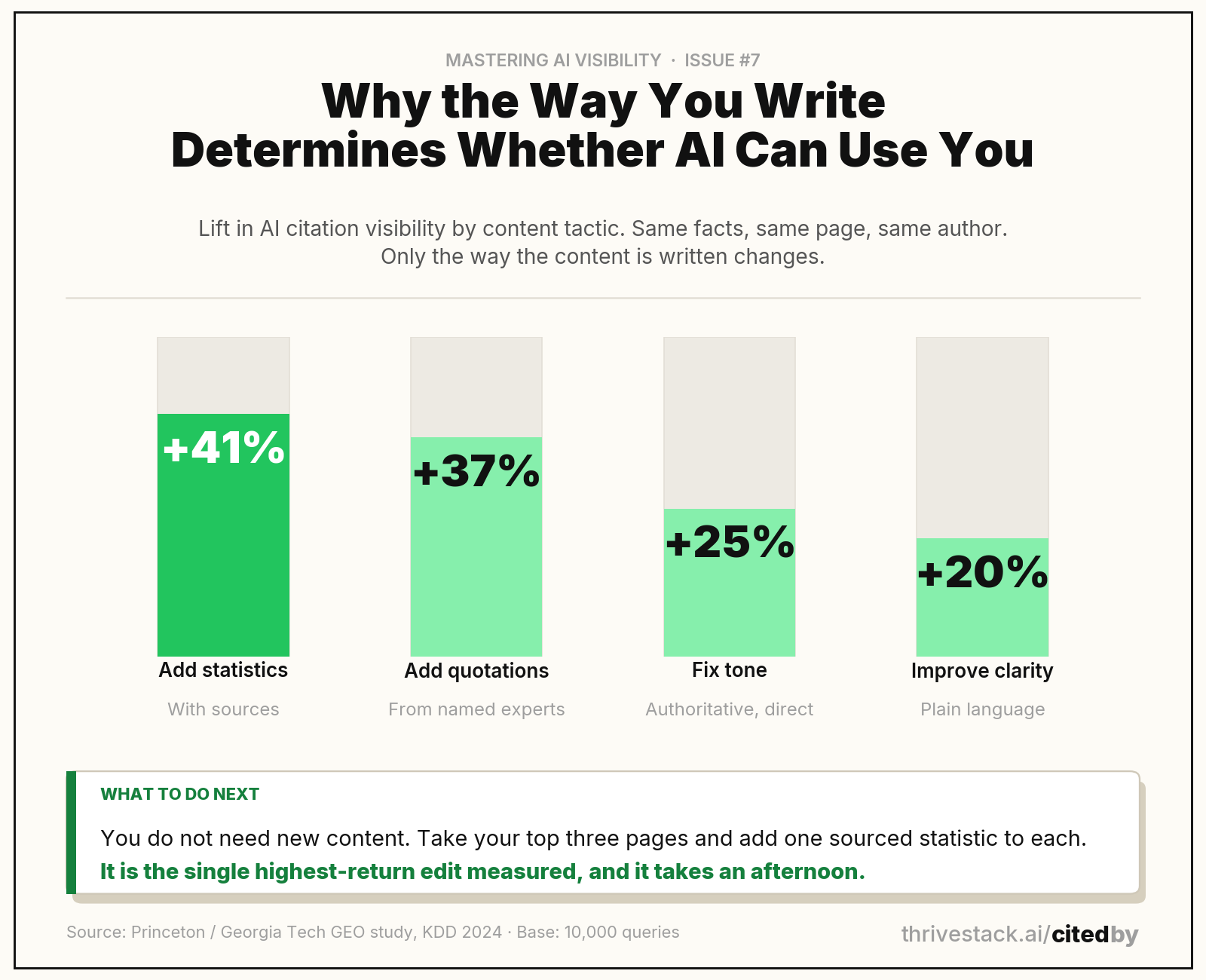
Adding one sourced statistic to a page lifts its AI citation visibility by 41%. Not rewriting it. Not lengthening it. Adding a number with a source attached.
That figure comes from the Princeton and Georgia Tech GEO study, presented at KDD 2024 and run across 10,000 queries. It is the most rigorous piece of research in this entire field, and almost nobody in marketing has read it.
The same study measured quotations from named experts at +37%, authoritative tone at +25%, and plain clarity at +20%. Same facts. Same page. Same author. The only variable is how the content is written.
+41%
Citation visibility lift from adding statistics with sources.
Quotations +37%. Tone +25%. Clarity +20%.
Princeton / Georgia Tech GEO study · KDD 2024 · Base: 10,000 queries · arxiv.org/abs/2311.09735
Why the classic blog format loses
The standard marketing article builds. Context, then nuance, then the answer somewhere near the end, ideally after a CTA. It is written to hold a human reader who has already decided to stay.
An engine does not stay. It extracts. It takes the cleanest, most quotable claim it can find, and it prefers to find it near the top. A page that withholds its answer for nine paragraphs is a page that gets skipped in favour of one that leads with it.
This is the cheapest fix in the entire discipline, and it requires no new content. You are reordering what you already have.
|
|
Definition Block, for "What is X?" queries
"[Product/concept] is [precise description] for [specific audience]. It [core benefit] by [mechanism]." Lead every category page and product page with this structure. Keep it under 60 words.
|
|
|
Statistics Block, for "Why does this matter?" queries
Lead with the number, then the source, then the implication. "AI-referred visitors convert at 4.4× the rate of organic traffic (Semrush, 2025), meaning your AI citation program directly impacts pipeline, not just awareness."
|
|
|
FAQ Block, for high-intent buyer questions
5–8 direct Q&As on every key page. Each answer: 40–60 words, complete and self-contained. Phrase questions exactly as buyers ask them in AI tools: "What is [X] and who is it for?"
|
|
|
Comparison Block, for "[X] vs [Y]" and "best [category]" queries
A structured HTML table beats prose every time. AI extracts tabular comparisons with high fidelity. If you're running comparison content as flowing text, restructure it. Today.
|
"Zero-click content is content that provides value without requiring a click. It is self-contained, and it teaches or entertains on the platform it is on."
 |
Amanda Natividad
SparkToro · on zero-click content
|
Source: Amanda Natividad, SparkToro
This week's fix
Take your three highest-value pages. Move the core answer into the first fifty words of each. Then add one statistic, with its source, to each.
That is an afternoon of work against a measured +41% on the single strongest tactic in the literature. Nothing else in AEO has this return-to-effort ratio.
Frequently Asked Questions
How do I write content that AI will cite?
Lead with the answer. Put the core claim in the first fifty words, under a heading that matches the question. Then support it with a sourced statistic, because the Princeton GEO study measured that at +41% citation visibility, and a quotation from a named expert, measured at +37%. Then keep the language plain. Clarity alone was worth +20%.
Do I need to rewrite all my content?
No, and you should not try. Take your top twenty pages by business value and restructure those. The GEO study's lifts come from format changes, not from new material, so this is reordering and annotating work rather than writing work.
Does content length matter for AI citation?
Far less than structure does. A short page that answers the question cleanly beats a long page that buries it. Length only helps when it is used to cover more of the query fan-out, which is a different problem and the subject of Issue #6.
What is answer-first writing?
Stating the conclusion before the reasoning. The classic newsroom version is BLUF: bottom line up front. For AEO it means the first paragraph must be extractable as a standalone answer, because that is frequently all an engine will take.
Be in the next issue
Have you run this and measured it?
This newsletter is trying to work out whether AI visibility is a real channel or an expensive story. That gets settled by operators, not vendors. If you have run a programme and have numbers, good or bad, we want the case study. The ones that did not work are worth as much as the ones that did.
Book 15 minutes →
A 15-minute walkthrough, no pitch. cal.com/thrivestack/citedby-ai-visibility
|