

In partnership with

Find what’s slowing your GTM.

Most GTM problems aren’t one big failure. They’re one or two weak spots quietly dragging down the rest.
The free GTM Audit scores your go-to-market across four dimensions, then sequences a 90-day roadmap for your stage.
Drop your URL. Get your score in about 10 minutes.
Share of voice is the percentage of a category’s conversation that belongs to you. In advertising it was your spend against total category spend. In SEO it was your ranking positions weighted by search volume.
In AI search it becomes simpler and more brutal. It is the share of your buyers’ questions where an engine names you rather than someone else. Call it Share of AI Voice.
It is brutal because there is no second page to hide on. In a generated answer you are named or you are absent. A brand sitting at position eleven on Google still exists. A brand not mentioned in the answer does not.
The formula
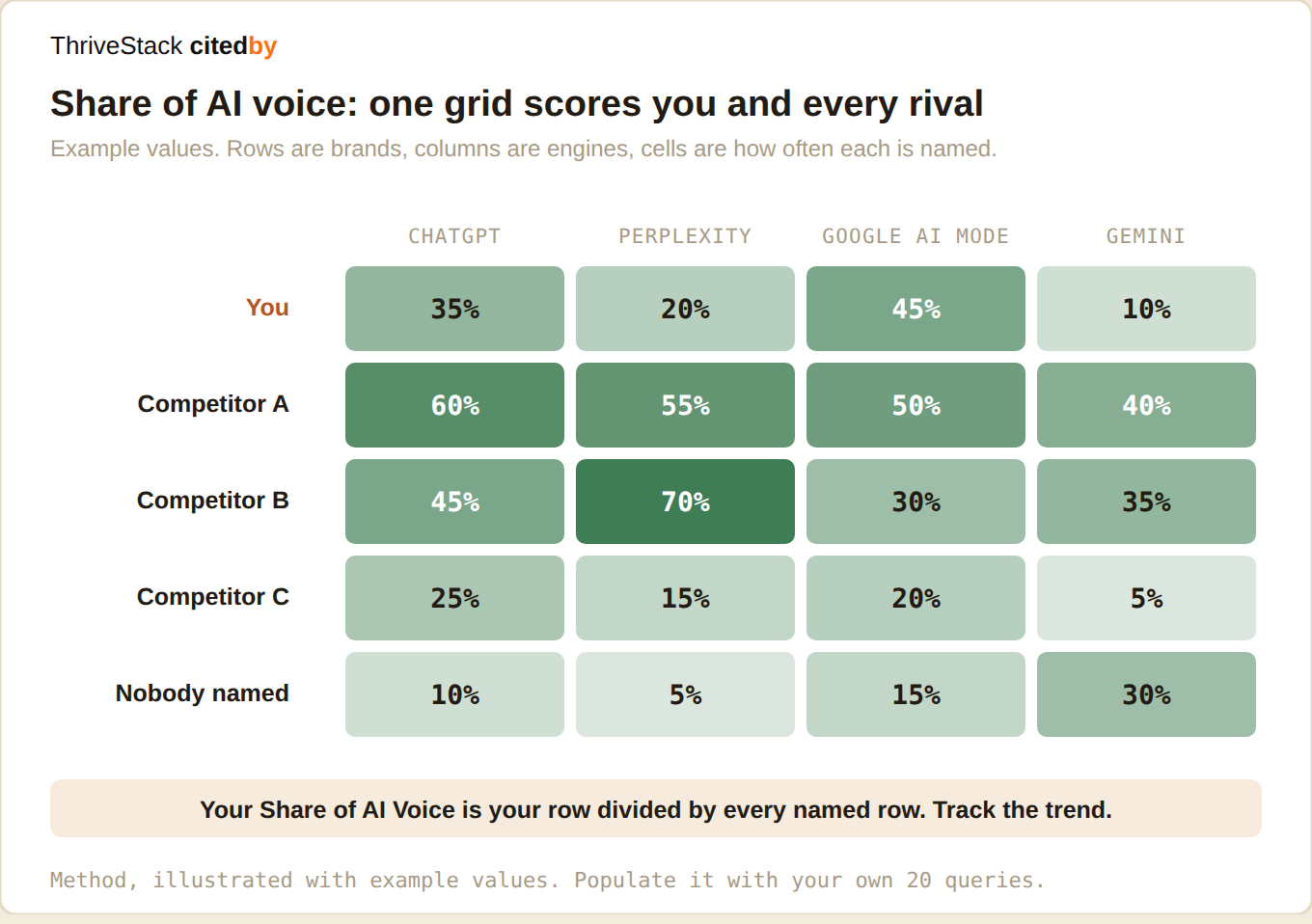
For a defined set of buyer queries, on a defined engine: your Share of AI Voice is the number of queries where you are named, divided by the number where any vendor is named.
That denominator matters. Queries where the engine names nobody are not losses, they are unclaimed territory, and they are frequently the most valuable rows in the grid. If nobody is being cited for a question your buyers ask, that is an open goal.
Queries where nobody is named are unclaimed territory, not losses.
Why you cannot blend the engines
Because your visibility is not one number. Citation sets diverge sharply between engines on the identical query. A single blended score will average a strong Perplexity result against a weak ChatGPT one and tell you that everything is fine, right up until you notice your buyers are all on ChatGPT.
Score each engine separately. Report each engine separately. It is more work and it is the only version that is true.
Building the grid
Twenty buyer queries down the side. The engines your buyers actually use across the top. Then run each query on each engine, weekly, and record three things: were you named, were your competitors named, and was anyone named at all.
It is a spreadsheet. It stays a spreadsheet until the manual run becomes the bottleneck. Buying a platform before you have a baseline is how teams end up with a dashboard nobody trusts.
What to do with the number
Almost nothing, on its own. A Share of AI Voice of 22% means very little without a trend. What it gives you is a line you can put in a board deck and move.
The competitive read is where it earns its keep. Score three competitors in the same grid and you are no longer reporting an SEO metric. You are reporting a competitive position, and that is a conversation your leadership already knows how to have.
Frequently Asked Questions
What is share of voice in marketing?
How do you measure share of voice in AI search?
What is a good AI share of voice?
What about queries where nobody is named?
Have you run this and measured it?
This newsletter is trying to work out whether AI visibility is a real channel or an expensive story. That gets settled by operators, not vendors. If you have run a programme and have numbers, good or bad, we want the case study. The ones that did not work are worth as much as the ones that did.
Book 15 minutes →A 15-minute walkthrough, no pitch. cal.com/thrivestack/citedby-ai-visibility