

In partnership with


The best marketing ideas come from marketers who live it.
That’s what this newsletter delivers.
The Marketing Millennials is a look inside what’s working right now for other marketers. No theory. No fluff. Just real insights and ideas you can actually use—from marketers who’ve been there, done that, and are sharing the playbook.
Every newsletter is written by Daniel Murray, a marketer obsessed with what goes into great marketing. Expect fresh takes, hot topics, and the kind of stuff you’ll want to steal for your next campaign.
Because marketing shouldn’t feel like guesswork. And you shouldn’t have to dig for the good stuff.
Nobody knows, and anyone who tells you otherwise is guessing or selling. That is the honest answer, and it is worth more to you than a ranked list would be.
As of July 2026 no vendor in this category has published a controlled before-and-after on a domain they do not own, with a holdout, over a defined period. Not one. What you get instead is case studies with no control group, where a brand did AEO work, improved, and the tool was in the room.
We are not going to rank the tools. We are going to give you the questions that make a vendor uncomfortable, because those are the ones that tell you what you are actually buying.
on a domain they do not own, with a holdout, as of July 2026.
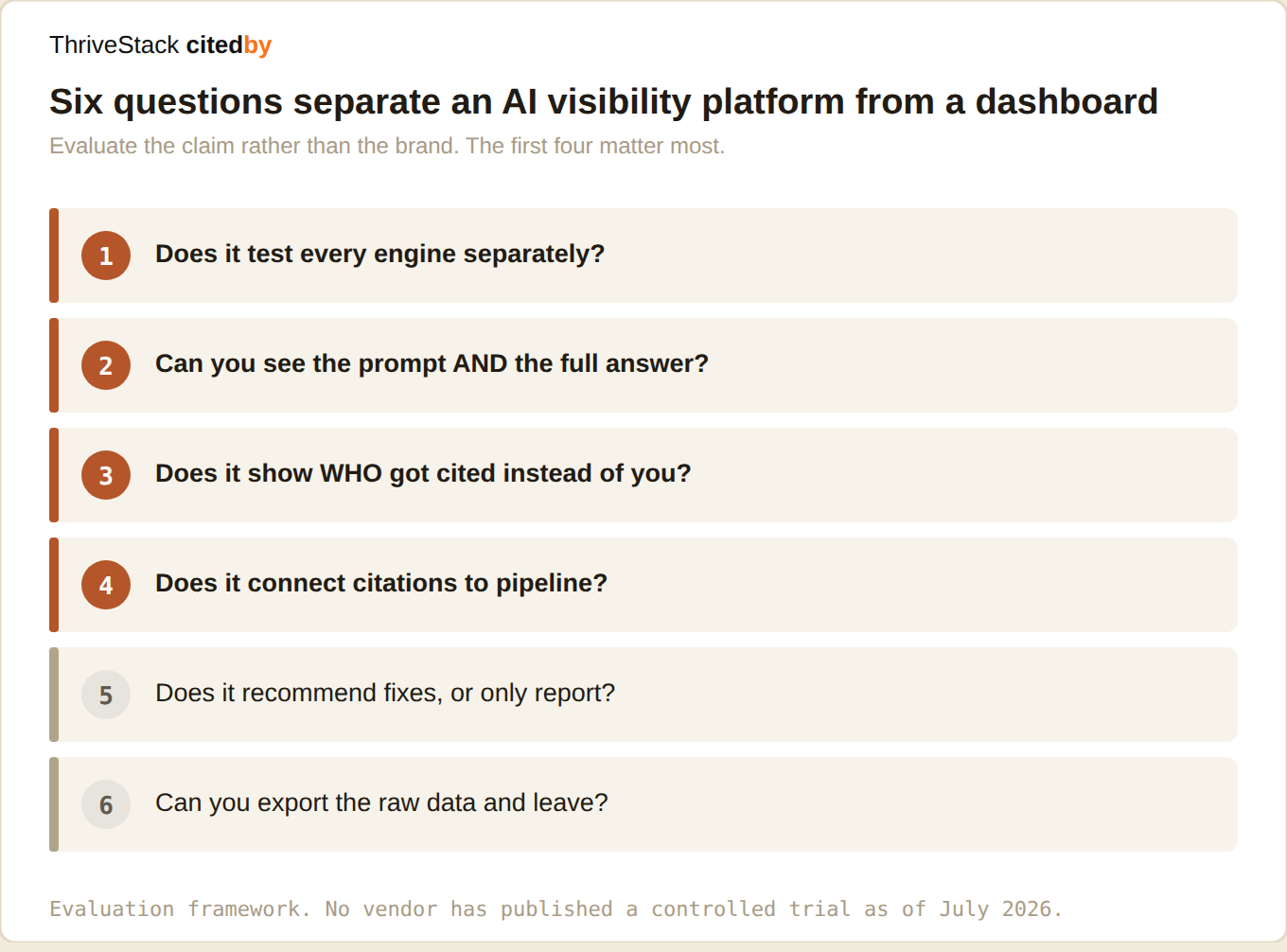
The six questions
1. Does it test every engine separately? A blended score averages a strong Perplexity result against a weak ChatGPT one and reports that you are fine. Citation sets diverge sharply between engines on the identical query. If a tool gives you one number, it is hiding the engine you are losing.
2. Can you see the prompt and the full answer? Not a citation count. The actual text the engine produced. A count with no answer text is unauditable, and unauditable numbers are how dashboards drift away from reality without anyone noticing.
3. Does it show who got cited instead of you? Your gap is not a percentage. It is a competitor name, attached to a specific query, on a specific engine. Without that you have a metric and no action.
4. Does it connect citations to pipeline? A citation is not a click. A click is not revenue. Ask any vendor to walk you through the chain from citation to closed-won, and watch how quickly the conversation becomes abstract.
5. Does it recommend fixes, or only report? Monitoring is a diagnosis. You are trying to buy a treatment. A tool that tells you your score is 28 and stops has sold you a thermometer.
6. Can you export the raw data and leave? If you cannot get your data out, you cannot verify it against reality, and you cannot switch. Lock-in is a product decision, and it tells you what the vendor thinks of their own retention.
What the category is actually good at
To be fair to the tools, and we should be: monitoring at scale is genuinely hard to do by hand. Running twenty prompts across six engines every week, capturing the answers, parsing citations and tracking the trend is real work, and software does it well.
What no tool can do is earn you a third-party citation. That is a PR problem, a customer-review problem and a community-presence problem. The strongest trust signal AI engines reward is third-party citations, scoring 4.5 to 4.8 across every engine NP Digital tested. No dashboard moves that number for you.
So what should you buy?
Start with a spreadsheet and twenty queries. It costs nothing and it produces the baseline you would otherwise be paying a vendor to produce badly.
Buy software when the manual run becomes the bottleneck, not before. And buy the one that answers the six questions above, not the one with the highest number on its own landing page.
Frequently Asked Questions
Which AI visibility tool works best?
What should I look for in an AI visibility platform?
Do I need a tool at all?
Can a tool improve my AI visibility?
Have you run this and measured it?
This newsletter is trying to work out whether AI visibility is a real channel or an expensive story. That gets settled by operators, not vendors. If you have run a programme and have numbers, good or bad, we want the case study. The ones that did not work are worth as much as the ones that did.
Book 15 minutes →A 15-minute walkthrough, no pitch. cal.com/thrivestack/citedby-ai-visibility