
In partnership with

The Future of AI in Marketing. Your Shortcut to Smarter, Faster Marketing.

Unlock a focused set of AI strategies built to streamline your work and maximize impact. This guide delivers the practical tactics and tools marketers need to start seeing results right away:
7 high-impact AI strategies to accelerate your marketing performance
Practical use cases for content creation, lead gen, and personalization
Expert insights into how top marketers are using AI today
A framework to evaluate and implement AI tools efficiently
Stay ahead of the curve with these top strategies AI helped develop for marketers, built for real-world results.
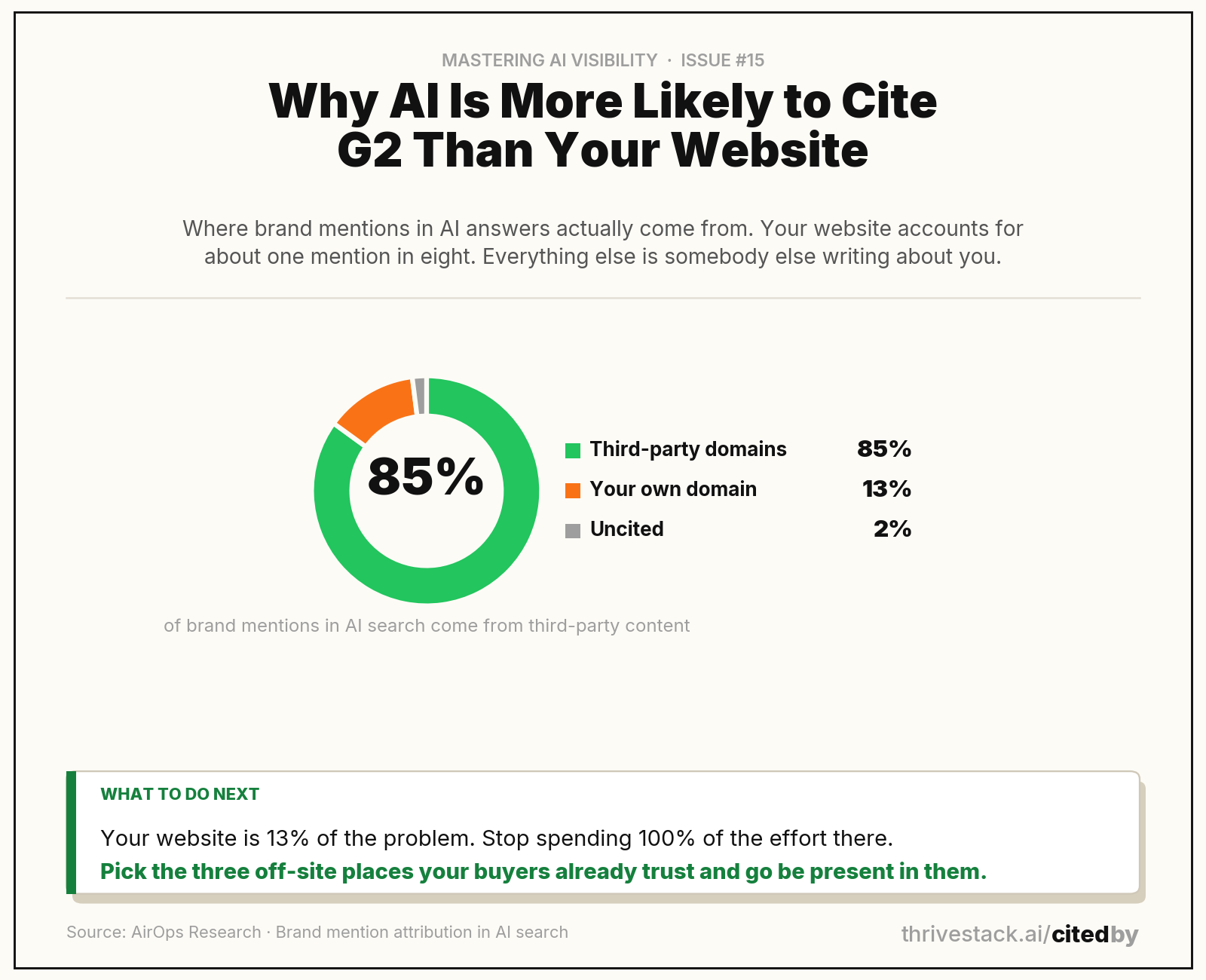
85% of brand mentions in AI search come from third-party content. Your own domain accounts for 13%. Two percent are uncited.
So roughly one mention in eight is something you wrote. The other seven are somebody else writing about you, on a property you do not own and cannot edit.
This is uncomfortable, and it is the most useful fact in the newsletter. It means the majority of your AI visibility is being decided in places your marketing team does not currently work.
Where brand mentions in AI search actually originate.
Why third-party sources win
Because you are an interested party and the engine knows it. Your website is a sales document. A review platform, a community thread, an analyst note, a trade publication: those are witnesses. The engine weights witnesses over defendants, and it is right to.
This is the same mechanism as the 0.664 correlation from Issue #5, seen from the other side. Corroboration is what earns citation, and corroboration by definition cannot come from you.
- "[Your brand] reviews". What does AI say your customers think? Is it citing G2? A Reddit thread? A blog post? Or nothing at all?
- "[Your brand] vs [competitor]". Where does comparison content come from? If AI is citing a competitor's comparison page rather than yours, that's a content gap to close.
- "Is [your brand] good?". This is what "The Scrambler" buyer asks after they've already seen your brand cited once. What sources does AI draw from?
- "Best [your category] for [your ICP]". The highest-intent category query. Are you cited? In what position? Which sources does AI draw from for the brands that are cited?
The channels that actually carry citations
|
Review Platforms (G2, Capterra, TrustRadius)
G2 is your highest-ROI channel. When AI answers "best [category] tool," it draws directly from G2 category rankings and review language. Your G2 profile needs: 20+ verified reviews, your canonical brand description in the About field, accurate category tagging, and responses to recent reviews. A complete G2 profile with 20+ reviews contributes more to AI citation than most blog posts you'll publish this quarter. |
|
Community Platforms (Reddit, Quora, Slack)
AI cites Reddit for problem-first queries ("why is X happening" and "how do I fix Y") before buyers know which category of tool they need. Authentic, helpful community participation puts your brand into the citation pool for high-intent queries early in the buyer journey. The rule: 10 genuine, value-first answers before any brand mention. Never self-promote. Mention your product only when directly, relevantly helpful. |
|
Editorial Press and Industry Publications
A mention in a trade publication is a Tier 2 corroboration signal. Each independent mention adds to the corpus of sources that confirm your brand is real, relevant, and worth citing. Priority targets: newsletters your buyers read (guest posts), analyst reports that cover your category, and review roundups on high-authority industry sites. Each press mention also contributes toward Wikipedia notability. The Tier 1 entity signal. |
 |
Jason Barnard Kalicube · on the Zero-Sum Moment |
Frequently Asked Questions
Why does AI cite review sites instead of my website?
Should I stop optimising my own website?
Which third-party channels matter most for B2B?
Can I control what third parties say about me?
Have you run this and measured it?
This newsletter is trying to work out whether AI visibility is a real channel or an expensive story. That gets settled by operators, not vendors. If you have run a programme and have numbers, good or bad, we want the case study. The ones that did not work are worth as much as the ones that did.
Book 15 minutes →A 15-minute walkthrough, no pitch. cal.com/thrivestack/citedby-ai-visibility