
In partnership with

Query Fan-Out: Why One Buyer Question Becomes 15 Sub-Queries
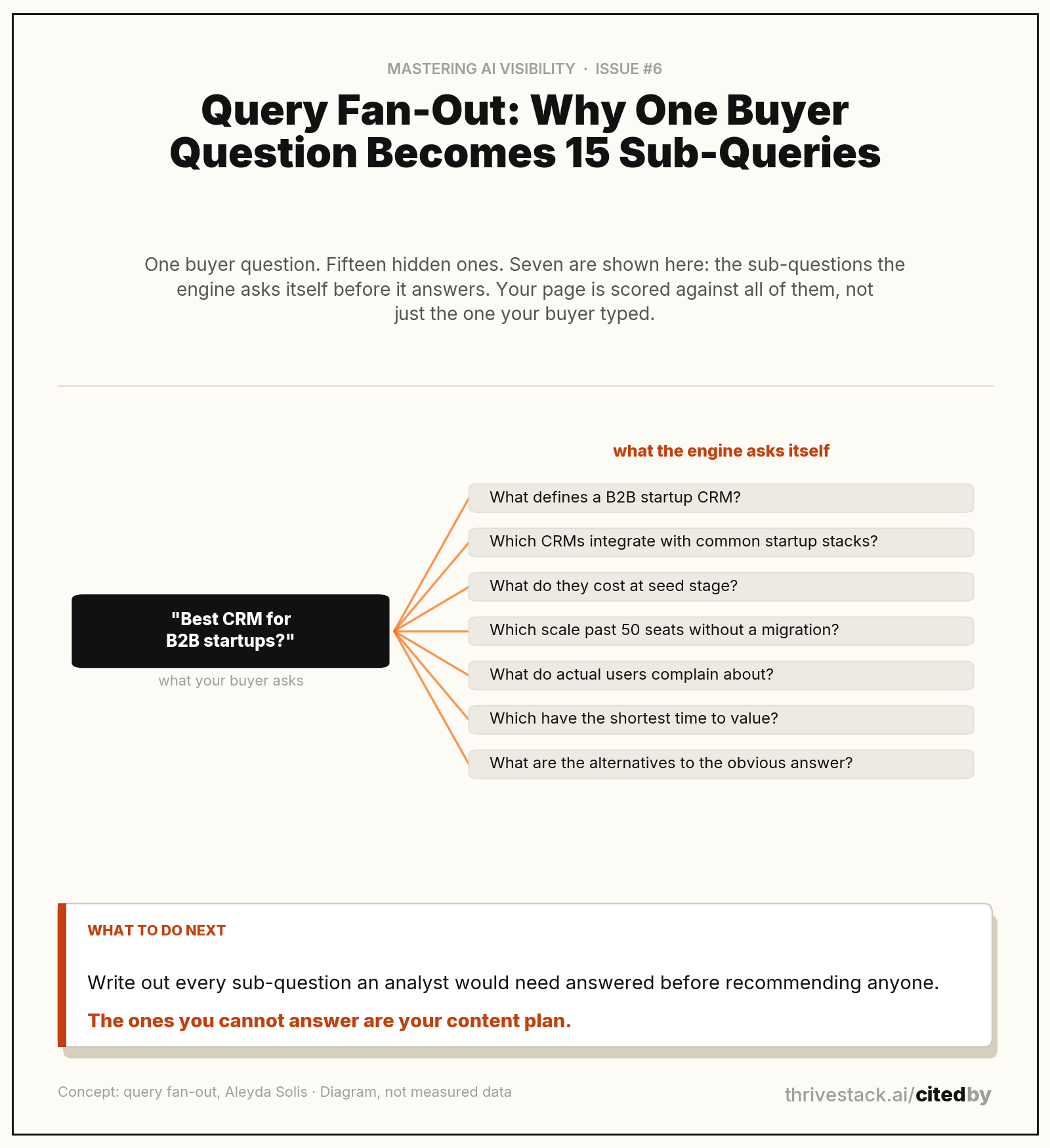
One buyer question, and the sub-questions the engine generates before answering. Concept: Aleyda Solís.
Your buyer asks one question. The engine asks itself ten to fifteen. Before it writes a word, it decomposes the question into sub-queries, retrieves against each, and assembles an answer from whatever it found. This is query fan-out, and Aleyda Solís named it.
It changes what "covering a topic" means. You are not being scored against the question your buyer typed. You are being scored against every sub-question the engine generated on the way to answering it.
Miss four of those sub-questions and a competitor fills them. The engine cites them for those parts, and once it is citing them, it tends to name them in the summary too.
- -> What CRM features matter most for early-stage B2B sales?
- -> Which CRMs integrate with Slack, email, and common B2B tools?
- -> What does a startup-friendly CRM cost per seat?
- -> How does [product A] compare to [product B] for startups?
- -> What CRMs offer a free tier or trial for early teams?
- -> What do G2 and Capterra reviews say about each option?
- -> Which CRMs scale from 5 to 50 sales reps without re-platforming?
- -> What migration support do CRM vendors offer?
- -> Is [specific product] good for outbound vs. Inbound-heavy teams?
- -> What implementation time should a startup plan for?
The AI brief curated by Anthropic and ex-Google engineers

Thousands of AI papers, model releases, and product launches ship every week. You don't need all of them. You need the ten that matter.
TLDR AI is the free daily newsletter curated by Anthropic and ex-Google engineers. People who build AI for a living read everything, then send you what's actually worth your time: the models, research, and tools that will still matter next month.
No hot takes, no hype cycles, no 60-tweet threads. Clear summaries you can read between meetings.
Join 1.1M+ readers. Subscribe for free.
The fan-out audit
The method is unglamorous. Take one buyer question. Write down every sub-question a thorough analyst would need answered before they could responsibly recommend a vendor. Then score your content against that list.
1 | Choose one high-priority buyer question Pick the single most important question your target buyer asks at the research stage — the question that, if answered with your brand cited, would put you on the shortlist. Example: “What is the best AI visibility platform for B2B SaaS marketing teams?” Start with one question. The process is repeatable once you understand it. |
2 | Generate the full sub-query tree Open an AI tool and ask: “What are all the sub-questions you would need to answer fully before responding to: [your question]?” The AI will typically surface 10–20 sub-queries. Group them into categories: product capabilities, comparison and alternatives, use case fit, pricing and terms, trust and social proof, implementation. This is your fan-out tree. |
3 | Map your existing content to the tree For each sub-query in the tree, identify which of your existing pages addresses it — and whether the answer appears in the first 150 words. Create a spreadsheet: sub-query in column A, your page URL in column B, answer in first 150 words (yes/no) in column C. You are looking for gaps (no page addresses this) and depth failures (the page exists but the answer is buried). |
4 | Score your coverage Count the sub-queries you address vs. The total generated. A score of 2/12 = 17% coverage — typical for B2B sites that haven't done AEO work. A score of 9/12 = 75% — the threshold where AI tools begin to see you as a comprehensive source on the topic. Note which gaps represent new content to create vs. Existing content to restructure. |
5 | Check whether a competitor fills your gaps For each sub-query your content doesn't address, ask the AI tool that sub-question directly and record which source it cites. This tells you exactly which competitor is capturing the citation you're missing — and gives you a concrete content creation brief: write a better, more specific, more data-rich version with a direct answer in the opening paragraph. |
6 | Build the content gap list and prioritize From your audit, you now have two lists: (1) existing pages that need restructuring to move answers to the first 150 words, and (2) new content to create for uncovered sub-queries. Prioritize by sub-query frequency — sub-queries in the “product capabilities” and “comparison” clusters typically appear in more fan-out trees. Fix those first. |
Most B2B content answers the root question and stops. That is why so many well-written pages never get cited. They are complete as articles and incomplete as answers.
 | Aleyda Solís Orainti · The AI Search Optimization Roadmap |